EndGauge
The pressure gauge at the end of your centre pivot, made smart
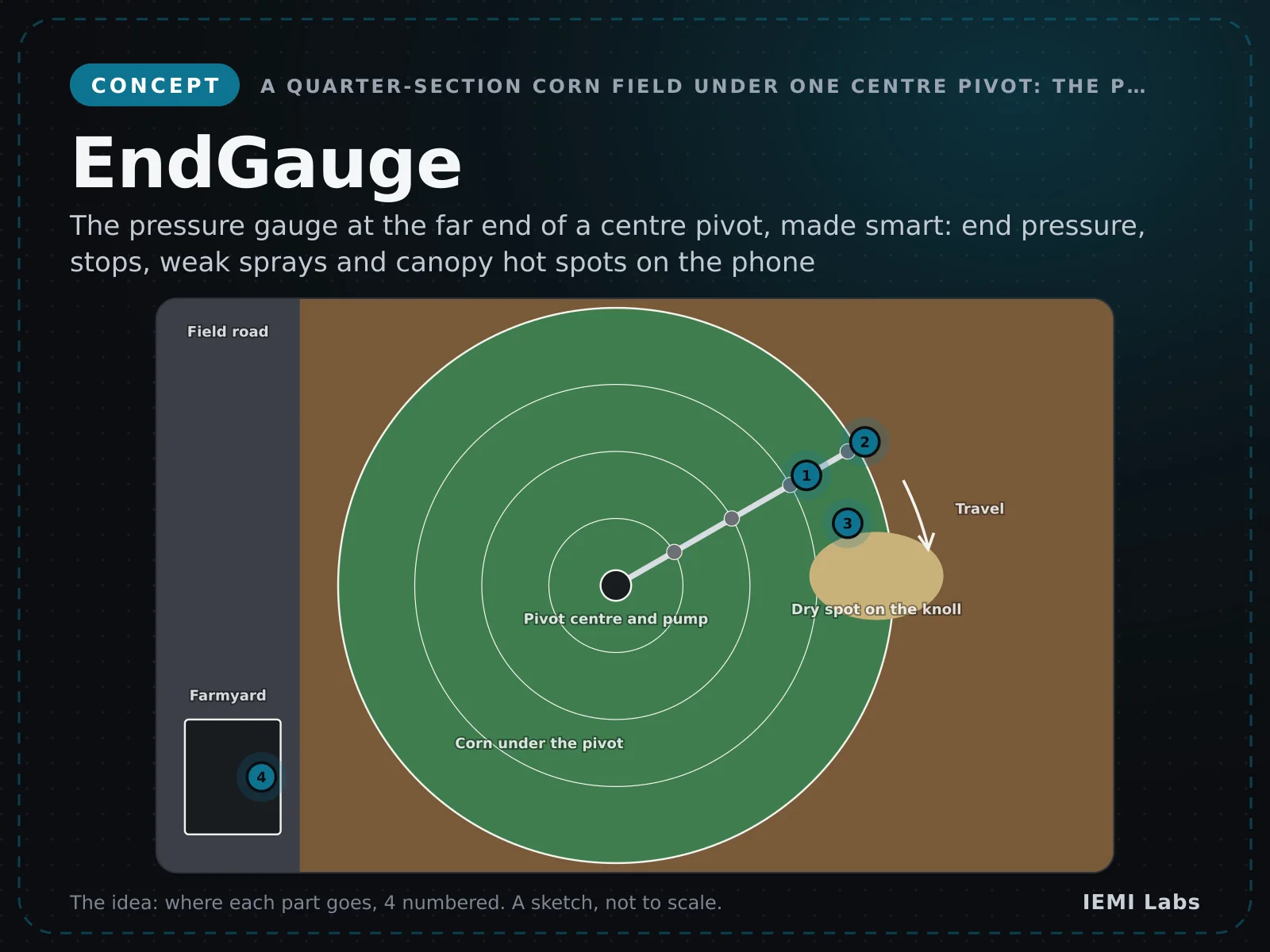
Reads end-of-pivot pressure, position and speed, checks the last span's sprays with a camera and maps canopy hot spots ahead of the water, then alerts your phone. Monitor only: it never controls the pivot.
- Who buys it
- Owners of older or mixed-brand centre pivots with no telemetry; later the pivot dealers who service them.
- Why it pays
- One broken nozzle about 1,000 ft out costs $600-1,000 of corn (University of Minnesota Extension); a 4 h stopped-wet event pumps about 7 acre-inches onto one spot, about $57 plus ruts (est.).
- Target price
- $499 kit + $60/pivot/year (target)
- First-minute wow
- A morning list on the phone: 'Drop 4 from the end: weak spray', with the photo, and the angle where end pressure falls below the regulator rating.
What the research found
And how this design answers it
- Stopped-wet and GPS alerts already sell for $299 (Pivot Watch) → kept as table stakes; effort goes into the pressure trend, spray check and thermal ring
- Extension says check pressure at the end, end gun on, on high ground → the transducer logs end pressure by angle and flags under-regulated angles (rating + 5 psi)
- A broken nozzle near the end costs the most → a camera looks back along the last span and flags weak or missing plumes
- Canopy temperature from the pivot is a proven stress signal (USDA ARS) → a forward MLX90640 pod maps a hot-spot ring, shown as 'scout here', not a stress number
- Must fit any brand without wiring → V-saddle and band clamps on any 5 9/16 to 8 5/8 in pipe, solar powered
Use case
Stopped wet at night, and a weak drop
OwnerHired handPivot dealer
- 01Trigger: the pivot stops at a crooked tower in a wet spot while the pump keeps running
- 02Detection: GNSS speed is zero for 3 min while the end reads 24 psi
- 03Alert: 'Stopped wet at 212 deg, 24 psi' to the owner's phone; next morning 'Drop 4 from the end: weak spray' with a photo
- 04Action: the hand shuts the pump and takes one regulator to the right drop
Outcome: About $57 of pumping and the ruts of a 4 h stopped-wet event avoided, and about 2 acres kept from under-watering (est.)
How it works
Architecture
- 01
Sense: end pressure every 10 s, GNSS every 60 s, thermal frame every 30 s, a camera frame every 2 deg of travel
- 02
Decide: state machine on the Walter (running wet/dry, stopped wet, end gun, under-regulated); spray check on the XIAO
- 03
Send: 200-byte state messages over LTE-M every 5 min while running, crops only for flagged drops
- 04
Tell: phone push with SMS fallback, pass report with the spray strip and thermal ring
Hardware
Real parts, buyable today
Bill of materials: about $479 at qty 1 (about $372 with a generic transducer, about $230 at qty 100, est.).
| Block | Part | Why this part |
|---|---|---|
| MCU + LTE-M + GNSS | DPTechnics Walter (ESP32-S3 + Sequans GM02SP) | Cellular and GNSS on one 55 x 24.8 mm board; pivots are far from Wi-Fi |
| Camera | Seeed XIAO ESP32S3 Sense (OV2640) | Checks drops on the last span on the device |
| Thermal | Adafruit MLX90640 55 x 35 deg (4407) | 32 x 24 canopy temperatures ahead of the water |
| Pressure | Honeywell PX3AN1BH100PSAAX 0-100 psi, 1/4 NPT | Rugged sealed-gauge transducer in a tee beside the dial gauge |
| Power | 2 x 18650 + bq24074 + Voltaic P126 6 W panel | 38 mW while running; 23 days with no sun (est.) |
Mechanical
Printable CAD
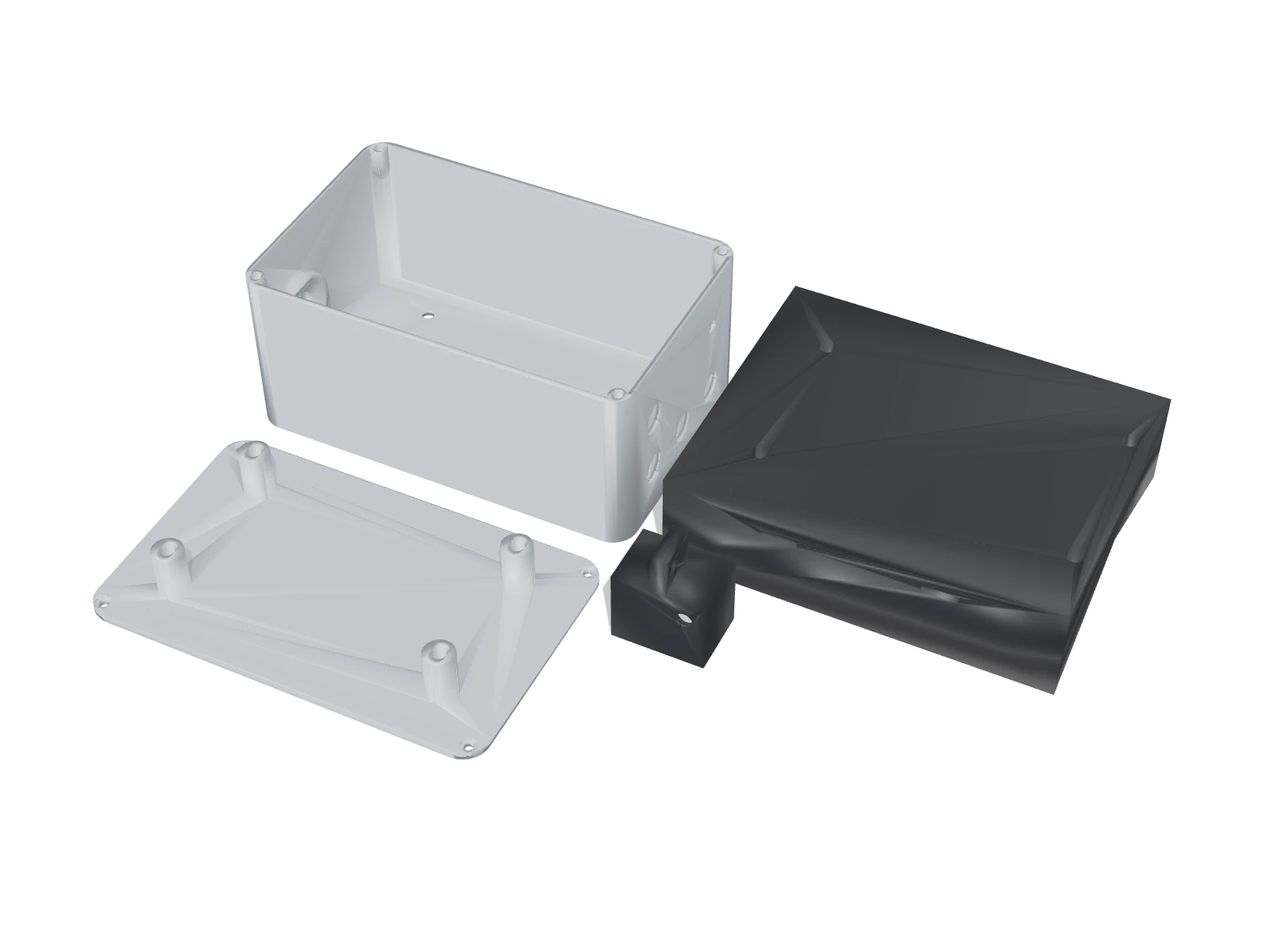
4 parts, generated from code and checked as closed solids. Pick a part to inspect it, or download the STL files to print.
See the CAD parts render
Loading the CAD…
Real CAD · drag to rotate · scroll to zoomReal CAD · swipe sideways
Bought hardware fitted inside this part (checked in the CAD: nothing collides with the plastic)
Open risks we are working on
- Lindsay or Valley can add a camera to their own monitors; Pivot Watch is cheaper
- The end camera checks single drops only 10-30 m back (about 10% of the field's water); full coverage needs a camera per tower
- One thermal pod maps a 3-8 m ring (under 4% of the field); value against a soil probe is untested
- The PX3 transducer is a quarter of the BOM; a generic one must hold calibration
- No irrigator or dealer interviews yet (gate G1); FTO on camera spray checks open (R1)
Design stage only: nothing on this page is for sale. Specifications and prices are targets.