SmokeSentinel AI
A solar daylight smoke spotter for ranches, rural communities and co-ops
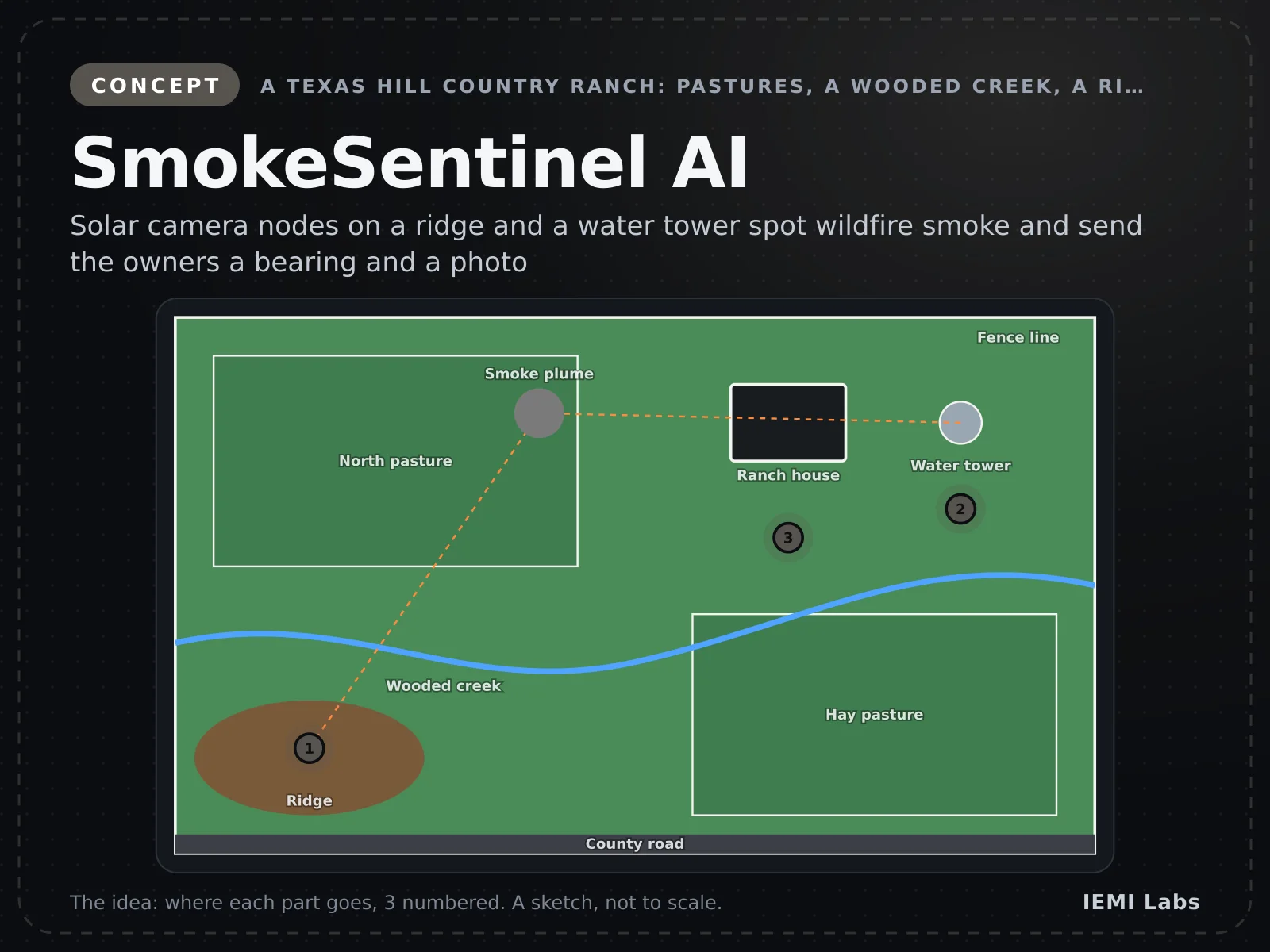
Watches the horizon from a ridge or tower, spots a growing smoke column and sends your group a bearing and photo over LTE-M or satellite text, so a person can call 911 sooner.
- Who buys it
- Texas ranch owners, Hill Country property-owner associations and Firewise committees, and electric co-op right-of-way managers.
- Why it pays
- Earlier initial attack on a pasture or brush fire saves fencing, hay, cattle and structures, often tens of thousands of dollars per incident (est.). A node costs about 4–5% of one $50,000/yr agency camera station.
- Target price
- $2,190 Ridge (2 cameras) or $2,690 360 (4 cameras) + $39/node/month (target)
- First-minute wow
- A red bearing line on the map and a photo of a thin grey column 6 km out; a minute later a second node's line crosses it and shows a location to read to 911.
What the research found
And how this design answers it
- Life-safety liability → positioned as a daylight spotter that tips people who call 911; no auto-dialling, no night smoke claims, only measured range and false-alarm numbers published
- Price no-man's-land ($4.9–6.9k + $199–349/mo) → about $1k of hardware sold at $2,190 + $39/mo for owners who will never buy a $50k/yr station
- Separate satellite modem → one nRF9151 with LTE-M and Skylo NB-NTN fallback
- Duty-cycled Hailo on a weak solar budget → always-on µA supervisor that powers the CM5 + Hailo-8L only in daylight or on red-flag nights; about 44 Wh/day with 11 days of autonomy
- Clouds, dust and planned burns → persistence-and-growth rule, road masks, owner-set mute zones and a sun-glare gate
- One camera can only give a direction → two nodes triangulate a location
Use case
Red-flag afternoon on a ranch
Ranch managerRanch handsVolunteer fire department
- 01Trigger: at 15:20, with humidity at 14%, a baler throws sparks into a hay field 6 km west
- 02Detection: in fire-weather mode the west camera sees a column grow across three frames 30 s apart
- 03Alert: the owner group gets bearing 268°, a cropped photo and 'about 5–7 km' over LTE-M
- 04Action: the manager confirms and calls 911 with the bearing; the volunteer fire department rolls with a direction from a known point
Outcome: Initial attack about 10 minutes earlier (est.); fences, hay and cattle spared
How it works
Architecture
- 01
Sense: 2 or 4 fixed 12 MP Camera Module 3 Wide cameras on a 1.5-inch pipe mast, plus a humidity sensor in a radiation shield
- 02
Decide: CM5 + Hailo-8L runs a smoke detector on horizon tiles every 30–60 s, with persistence and growth tracking
- 03
Send: nRF9151 sends the alert and a 40 kB crop over LTE-M, or a 34-byte text over Skylo satellite
- 04
Tell: push, SMS and voice to the owner group, a bearing map with triangulation, and an open CAP 1.2 feed
Hardware
Real parts, buyable today
Bill of materials: about $1,090 per Ridge pilot node including solar and battery, about $990 in production (est.).
| Block | Part | Why this part |
|---|---|---|
| Compute | Raspberry Pi CM5 4GB on CM5 IO Board + Hailo-8L M.2 | Same software stack as the Edge Hub; off at night to save power |
| Cameras | Raspberry Pi Camera Module 3 Wide (IMX708, 12 MP) | 45 px per degree, so a 50 m plume at 8 km is about 16 px wide |
| Radio + supervisor | Nordic nRF9151 (LooUQ MTC2-N9151 in production) | LTE-M plus Skylo-certified satellite fallback and GNSS, µA sleep |
| Power | 100 W panel + Victron SmartSolar 75/15 + 12.8 V 50 Ah low-temp LiFePO4 | Bought, listed parts; about 6× daily need in a Texas December |
| Enclosure | Printed white ASA head with double-skin sun roof | Keeps the head cooler in sun; no battery or mains in printed parts |
Mechanical
Printable CAD
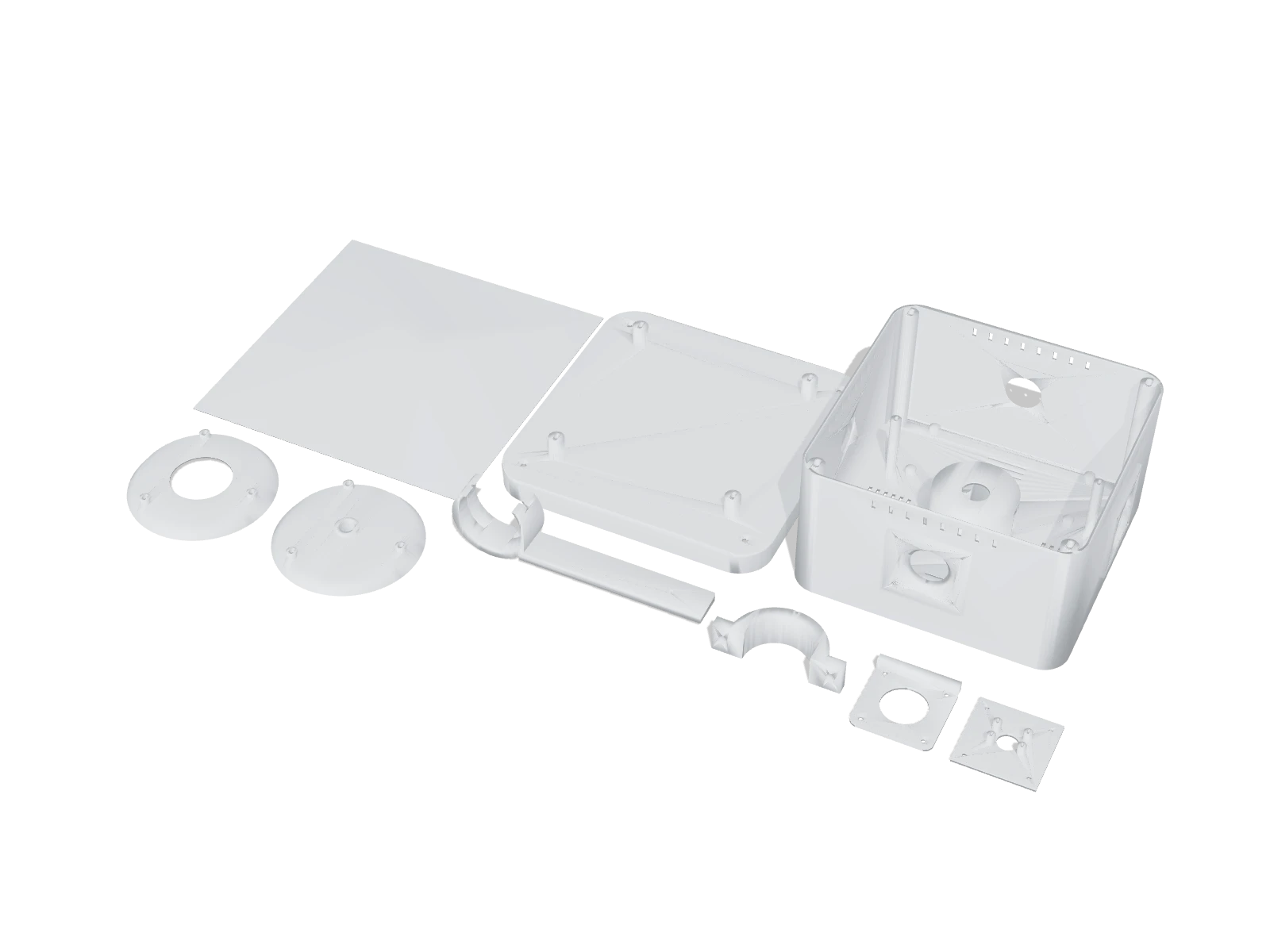
9 parts, generated from code and checked as closed solids. Pick a part to inspect it, or download the STL files to print.
See the CAD parts render
Loading the CAD…
Real CAD · drag to rotate · scroll to zoomReal CAD · swipe sideways
Bought hardware fitted inside this part (checked in the CAD: nothing collides with the plastic)
- Camera head bodyhead-body.stl · ASA
- Head caphead-cap.stl · ASA
- Sun roofsun-roof.stl · ASA
- Window retainerwindow-retainer.stl · ASA
- Camera mountcamera-mount.stl · ASA
- Mast collar halfmast-collar-half.stl · ASA
- Radiation shield plateshield-plate.stl · ASA
- Radiation shield capshield-cap.stl · ASA
- Radiation shield armshield-arm.stl · ASA
Open risks we are working on
- Real detection range and false-alarm rate in Texas haze, dust and cumulus are unmeasured
- Skylo NTN access, payload limits and pricing for a small US device are not confirmed
- Head and battery temperatures in a Texas August may force throttling or charge cut-off
- Carrier and PTCRB certification cost and time for a small-volume LTE-M device
- Demand: ranches may rely on neighbours and free agency cameras instead of paying a monthly fee
Design stage only: nothing on this page is for sale. Specifications and prices are targets.