LaundryRoom
One wall hub and a puck on each machine: uptime, cycle counts, coin checks, free-now page and water on the floor
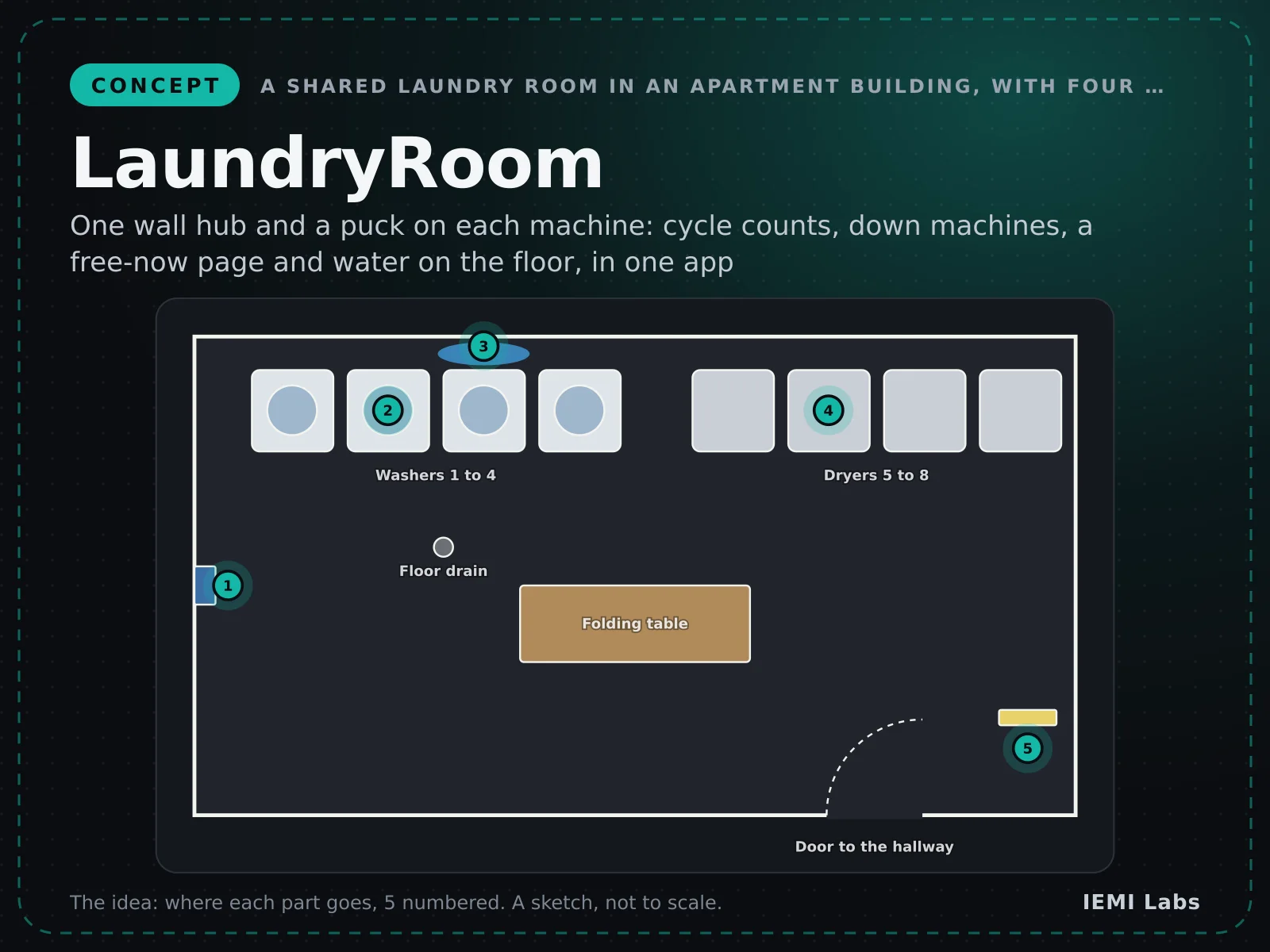
A battery puck on each washer and dryer counts every cycle and finds down machines; on washers the same puck watches a leak foot on the floor behind the machine. One wall hub runs every job and gives owners a coin and statement check, residents a free-now page and staff a leak alarm.
- Who buys it
- Owners and property managers of apartment buildings, condos and student housing with a shared laundry room, and owner-operators of small laundromats.
- Why it pays
- A burst washer hose costs about $5,300 a claim after the deductible (attributed to IBHS). For an 8-machine room LaundryRoom is $549 + $25/month instead of about $1,277 + $153/month for our three products separately (est.).
- Target price
- $549 room kit (hub + 8 pucks, 4 leak feet) + $25/room/month; extra puck $39 (target)
- First-minute wow
- At 07:42 the app says 'water behind washer 3'; on Monday it flags 'dryer 6 silent since Saturday', and on Sunday 'cycles say $371, statement says $318', all from the same puck on each machine.
What the research found
And how this design answers it
- Three products, five kinds of hardware (CT hub, CycleTap gateway, pucks, LoRa leak sensors, LoRa gateway) → one ESP32-C6 hub and one puck per machine
- Separate leak sensors with their own batteries and radios → the washer puck reads a wired leak foot behind its machine every 10 s
- LaundroLink needed an electrician for breaker-panel current sensors → stick-on pucks count cycles; no panel work
- WaterLeak's LoRa gateway → the hub's Wi-Fi or LTE-M carries the leak alarm
- New: an off-balance note when a washer shakes far harder than its normal spin (unproven)
- Riser valve shut-off stays with WaterLeak Building; LaundryRoom alerts only
Use case
A Tuesday morning in an 8-machine apartment laundry room
Property managerOn-call maintenanceResidentsLaundryRoom pucks and hub
- 01Trigger: at 07:42 the supply hose behind washer 3 starts to drip onto the floor
- 02Detection: water bridges the two contacts on the leak foot; the washer puck wakes and sends a leak frame
- 03Alert: the hub passes it on at once; on-call gets a push and a text, the manager an email
- 04Action: staff shut the washer's supply valve at 07:51 and mark the machine down; residents see it out of service on the free-now page
Outcome: A drip found in 9 minutes instead of after a day, one machine out instead of a flooded room, and a log for the insurer; one avoided hose claim is worth about $5,300 (attributed to IBHS)
How it works
Architecture
- 01
Sense: in each puck an LIS2DW12 feels the drum and an LIS2MDL the motor field; washer pucks also read a leak foot through a 2-core lead
- 02
Decide: the puck's ESP32-C6 counts cycles and checks the foot; the hub's ESP32-C6 runs uptime, off-balance and alarm rules for the room
- 03
Send: pucks to the hub over BLE; the hub to the cloud over Wi-Fi or LTE-M, MQTT over TLS
- 04
Tell: one LaundryRoom app with free-now, down machines, money check, fault reports and leak alarms
Hardware
Real parts, buyable today
Bill of materials: about $23 per puck, $1.50 per leak foot and $58 per hub at qty 10; about $250 per 8-machine room kit at qty 1 (est.).
| Block | Part | Why this part |
|---|---|---|
| Brain | Espressif ESP32-C6-MINI-1 in the wall hub | Hears every puck over BLE and runs every job; Wi-Fi 6 on the same chip |
| Uplink | SIMCom SIM7080G LTE-M | Basement rooms rarely have usable Wi-Fi |
| Cycle sensing | ST LIS2DW12 + LIS2MDL in each puck | Vibration plus motor field tells this machine from its neighbour |
| Leak sensing | Printed leak foot with two A2 stainless contacts | Uses the washer puck's battery and radio; no separate sensor |
| Power | 2 × Energizer L91 + TI TPS63900 | Years per puck on two AA cells (target) |
Mechanical
Printable CAD
12 parts, generated from code and checked as closed solids. Pick a part to inspect it, or download the STL files to print.
Loading the CAD…
Real CAD · drag to rotate · scroll to zoomReal CAD · swipe sideways
Bought hardware fitted inside this part (checked in the CAD: nothing collides with the plastic)
- Hub base (wall side)hub-base.stl · PETG
- Hub lidhub-lid.stl · PETG
- Puck toppuck-top.stl · PETG / ASA, white
- Puck base with leak lead holepuck-base.stl · PETG / ASA, white
- Puck battery doorpuck-battery-door.stl · PETG / ASA
- Puck mount platepuck-mount-plate.stl · PETG / ASA
- Anti-slip padanti-slip-pad.stl · TPU 95A
- Machine tagmachine-tag.stl · PETG, teal
- Leak footleak-foot.stl · PETG, black
- Lead cliplead-clip.stl · PETG or TPU
- QR fault placard holderqr-placard-holder.stl · PETG
- Free-now sign standfree-now-sign.stl · PETG
Open risks we are working on
- Leak foot contacts sit 0.5 mm above the floor: a sloped or uneven floor can keep water away from it; placement at the low point is part of the bench test
- Detergent film and lint can make a false wet reading over time; contacts need a yearly wipe (est.)
- BLE from a puck on a steel cabinet to the hub must be proven in real rooms; CycleTap's range is unproven
- Very smooth washers are the hardest case for cycle counting
- It alerts only and does not close a valve; route operators may object to pucks on their machines (contract clauses)
- Off-balance notes are a new idea and unproven
Design stage only: nothing on this page is for sale. Specifications and prices are targets.