CareWatch
Camera-free room activity and check-in prompts for care staff
Tells the on-shift carer which room to check and why (too long in the bathroom, no movement, not up by the usual time) using 60 GHz radar, with no camera and nothing to wear. Not a medical device.
- Who buys it
- US assisted-living and memory-care operators (director of wellness) and non-medical home-care agencies that sell a remote check-in add-on.
- Why it pays
- About $9–14k/yr of targeted night-check time for a 40-unit building (est.), and a $39–59/month check-in add-on for agencies against $12/month to IEMI (est.).
- Target price
- $129 per room (Wi-Fi) or $159 (LTE-M) + $8/room/month, or $12/client/month for agencies (target)
- First-minute wow
- A carer's phone shows "Room 12: in bathroom 20 min (usual 6). Please check." with one-tap acknowledge, and the director sees every response time.
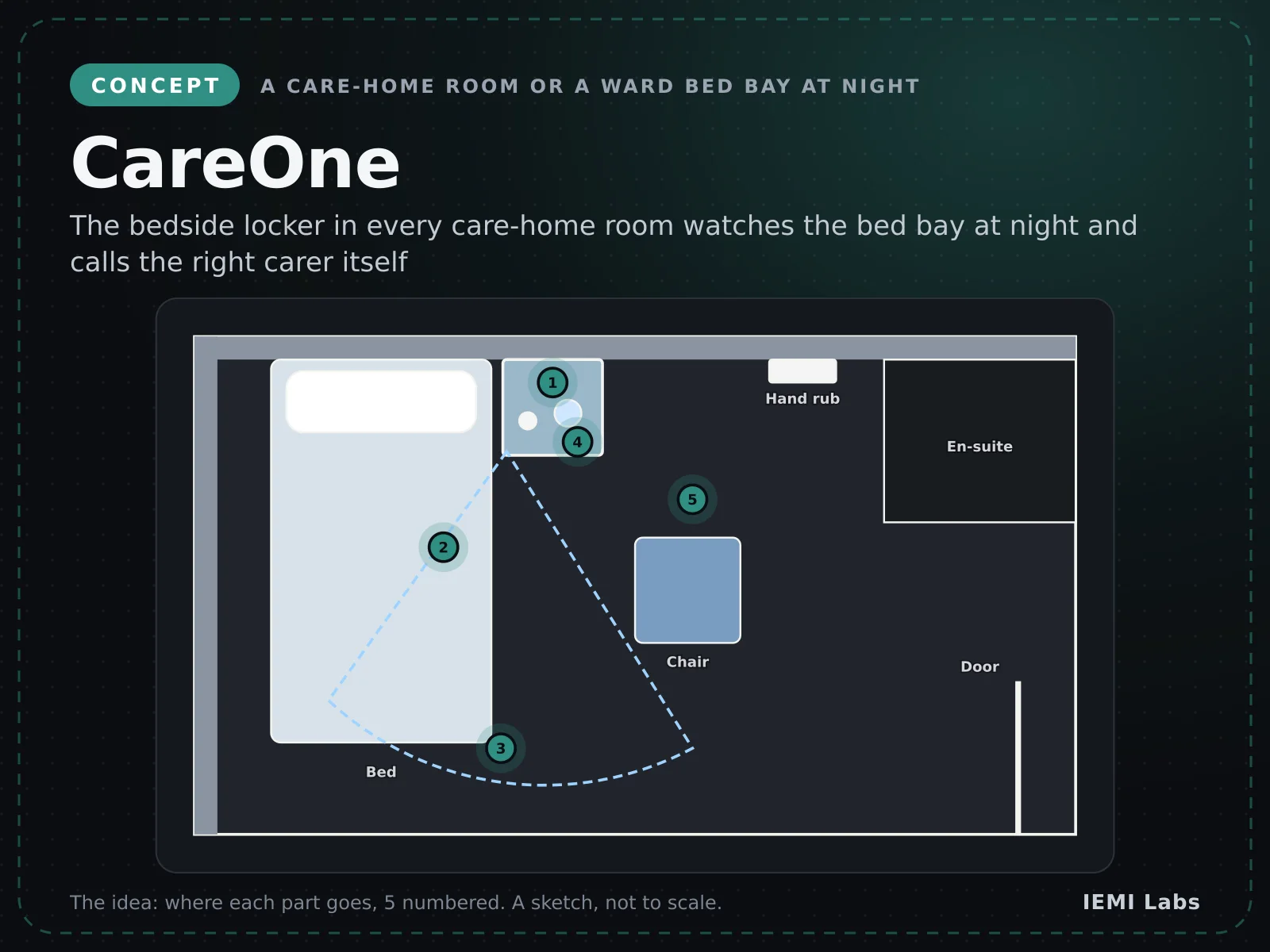
What the research found
And how this design answers it
- Fall/medical claims were uninsurable → non-medical intended use, radar fall flag switched off, "please check" wording, claim rules in DESIGN §8
- Vayyar (~$240 + $19.99/mo consumer) and Nobi (~$2,500/apartment) → $129 + $8/room/month, bathroom-time and routine prompts, self-install
- Aqara FP2 at ~$58 sets a hardware price floor → the product is the fleet layer: rosters, escalation, acknowledgement audit, offline supervision
- Bathrooms have no socket and are wet → listed 5 V adapter outside the room, flat cable, 2 Ah ride-through cell, vents on the lower edge only
- A silent dead sensor is the real liability → 60 s heartbeat, offline alert in 5 min, daily self-test email
Use case
Long bathroom visit at 3 am
ResidentNight carerShift leadDirector of wellness
- 01Trigger: at 03:10 the resident goes into the bathroom; the room's usual night visit is 6 minutes and there is no shower humidity spike
- 02Detection: at 20 minutes the puck raises bathroom_long
- 03Alert: the carer's phone shows "Room 12: in bathroom 20 min (usual 6). Please check."; with no acknowledgement in 3 minutes it goes to the shift lead
- 04Action: the carer checks the room, taps Attended and records the outcome; the response time goes into the weekly report
Outcome: The right room is checked about 20 minutes in rather than at the next 2-hourly round; about $9–14k/yr of targeted night-check time per 40 units (est.)
How it works
Architecture
- 01
Sense: 60 GHz radar module (presence, motion, zones) plus SHT40 humidity for showers, in a 90 mm puck
- 02
Decide: ESP32-S3 runs zone dwell timers on the puck; the cloud applies 14-day per-room baselines
- 03
Send: MQTT over TLS on facility Wi-Fi, or LTE-M (nRF9151) in client homes; events and 1-minute bins only
- 04
Tell: carer phone app with acknowledge and escalation, director console, weekly counts report
Hardware
Real parts, buyable today
Bill of materials: about $59 per Wi-Fi puck, $90 LTE-M, at qty 100 (est.).
| Block | Part | Why this part |
|---|---|---|
| Radar | Seeed MR60FDA2 60 GHz module | Radar processing on the module, UART out, $30 kit for the pilot |
| MCU + radio | ESP32-S3-WROOM-1-N8R8 | Wi-Fi/BLE install, secure boot, zone logic |
| Humidity | Sensirion SHT40 | Shower detection stops false bathroom prompts |
| Power | BQ24074 + TPS63802 + 2 Ah LiPo | USB-C power with about 6 hours of ride-through |
| Cellular (home SKU) | Nordic nRF9151 + 1NCE SIM | Client homes often lack Wi-Fi the agency controls |
Mechanical
Printable CAD
6 parts, generated from code and checked as closed solids. Pick a part to inspect it, or download the STL files to print.
See the CAD parts render
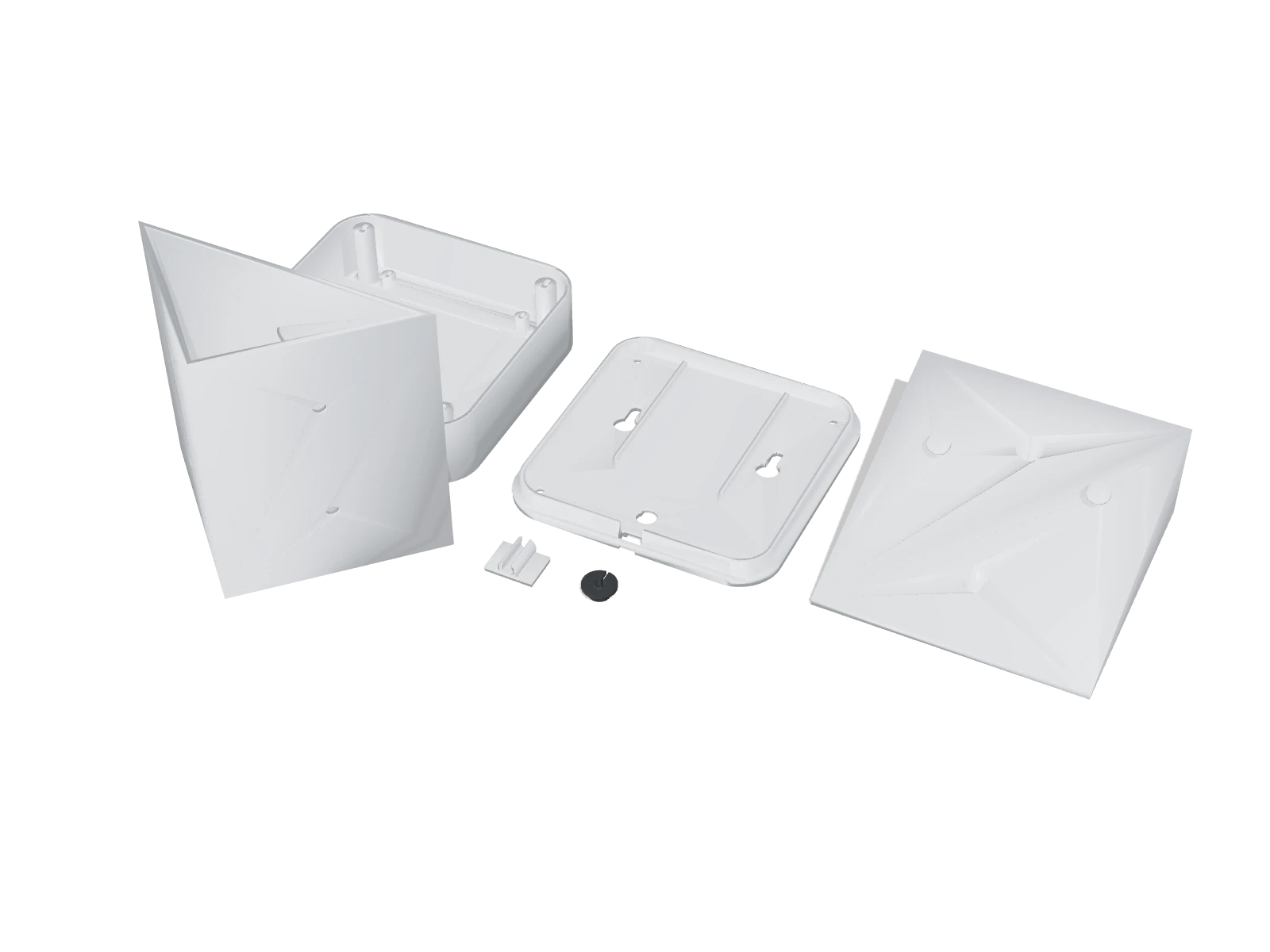
Loading the CAD…
Real CAD · drag to rotate · scroll to zoomReal CAD · swipe sideways
Bought hardware fitted inside this part (checked in the CAD: nothing collides with the plastic)
Open risks we are working on
- Operators may want fall detection and not settle for "please check" prompts (validate with 10 operator calls)
- Regulatory boundary: bed-exit fall-prevention alarms are FDA Class I (21 CFR 880.2400); counsel must approve the wording
- Single-source radar module; field of view and current draw not yet measured
- False prompts from pets, fans and two-person rooms until baselines settle
Design stage only: nothing on this page is for sale. Specifications and prices are targets.