PickleQuiet
Court noise evidence both sides can trust, quiet-gear hours checked court by court, and booked courts released and lights off when nobody turns up
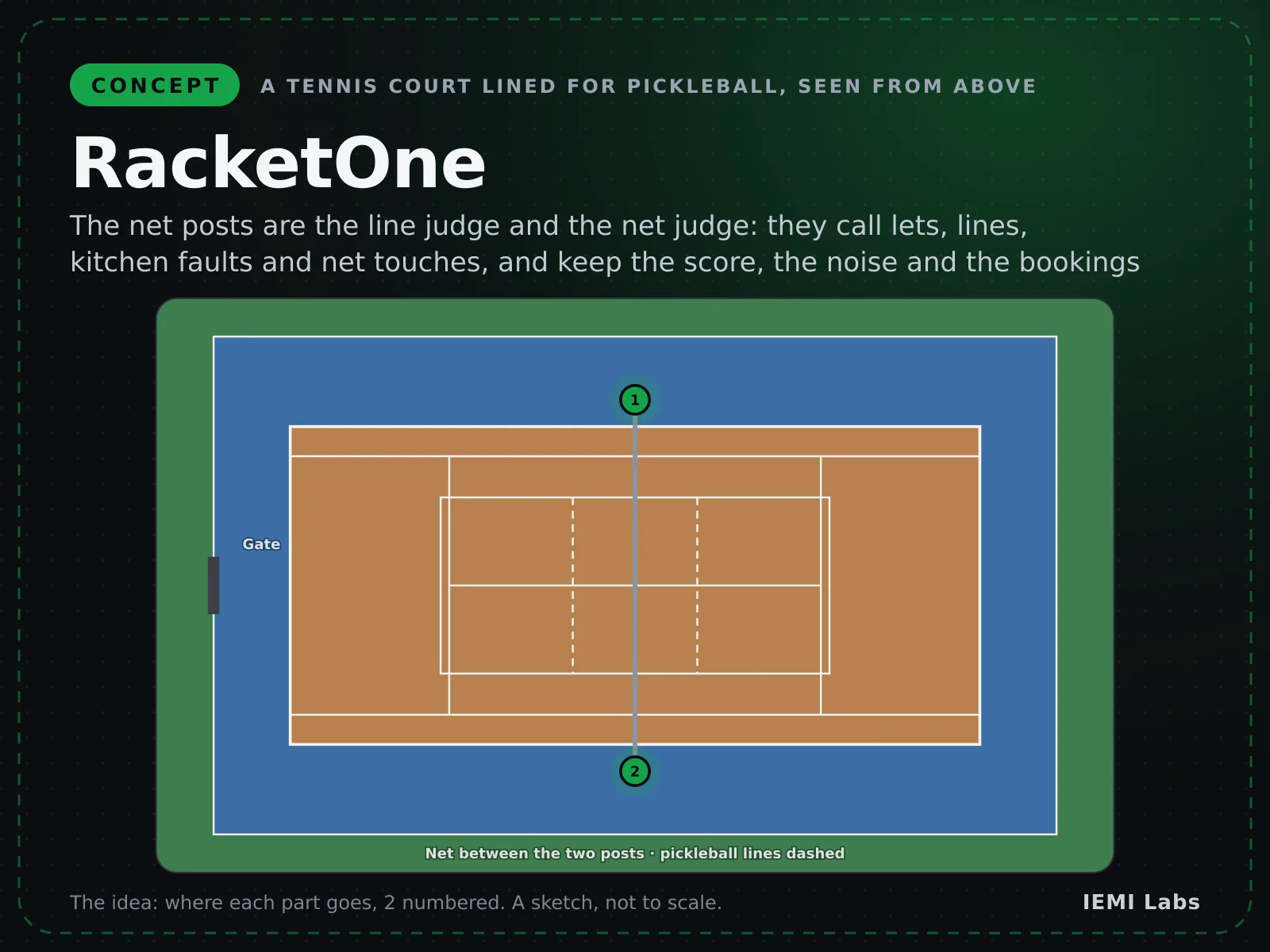
Counts paddle pops and logs A- and C-weighted noise levels on the device, with no audio stored or sent, so a court owner and the neighbours share one record. A QuietLight on each net post checks quiet-gear hours court by court and, new in rev A3 CourtLight, takes a CHECK IN press for each booking: if nobody checks in or plays within 10 minutes the court is released and its floodlights go off.
- Who buys it
- Tennis and pickleball clubs and councils with floodlit, bookable courts; parks departments and HOAs with courts near homes; acoustic consultants who rent fleets.
- Why it pays
- Continuous noise evidence for $899 + $39/mo against the cost of a closure or repeated consultant studies (est.). CourtLight: at £4–7.20 per court-hour of lights, a 4-court club with 3 no-show lit hours a week saves about £600–1,100 a year in lights and gets those hours back for members (est.).
- Target price
- $899 unit + $39/mo, or $1,200 per 60-day study rental; QuietLight with CHECK IN key $169 per court; 4-court CourtLight Kit $699 (4 lights + 2 floodlight relays, electrician extra); radar option +$149 (target)
- First-minute wow
- At 18:10 the court nobody turned up for goes dark and its screen says "Free court · booking released 18:10"; next door, the players who pressed CHECK IN keep their lights until 5 minutes after their hour, with an amber flash before they go off.
What the research found
And how this design answers it
- Booked courts left empty and floodlights burning for no-shows (Edmonton and North Hudson void a booking after 10 minutes, ClubSpark clubs after 10–15; lights £4–7.20 per court-hour and tied to the booking, not to who turned up) → a CHECK IN key on each net-post QuietLight, play heard or radar presence also counts, release and lights off at start + 10 minutes, amber warning before any switch-off, curfew honoured
- Quiet-gear rules nobody can check (Laguna Beach ordinance, Cupertino dawn–9 am and 7–9 pm request, Carmel banned play because quiet gear "would have required monitoring") → a QuietLight on each net post judges each pop by pitch, glows green or amber for the players, and gives the park per-court counts, no audio and no camera
- Lawsuits and closures over pickleball noise → continuous, signed, hash-chained hourly records plus a before/after view that proves mitigation
- Plain dB meters miss the impulsive ~1 kHz pop → on-device classifier (onset sharpness, 0.8–2 kHz spectral peak, duration, rally rhythm) with pop counts and an impulse penalty
- Microphone privacy worries in parks → audio only in a 21 ms RAM buffer, no code path to store or send it, audio module open-sourced
- MEMS mics are not type-approved meters → honest Class 2-target claim, per-unit check against a Class 1 reference, a 1/2-inch stalk for calibrator drift checks, and wind/rain/noise-floor flags
- ICS-43434 is end-of-life → Infineon IM69D130 mic, with TDK T5838 as the second source
- CourtPulse alone is a weak sale → the same pole unit and the same customer as PickleQuiet
Use case
A Tuesday-night no-show at a floodlit club
Club secretaryMembers with a bookingMembers waiting
- 01Trigger: courts 1 and 2 are booked 18:00–19:00 with lights; the floodlights come on at 17:55 for warm-up
- 02Detection: court 1 players press CHECK IN at 18:03; on court 2 nobody presses and no pops are heard by 18:10
- 03Alert: court 2 lights go off, its screen says "Free court · booking released 18:10", and the club gets one no-show line
- 04Action: the waiting members book court 2 on the app and its lights come back on; court 1 gets an amber flash at 19:00 and goes dark at 19:05
Outcome: One lit court-hour not wasted and one court back in use, with no staff on site (value est.)
How it works
Architecture
- 01
Sense: an IM69D130 mic on the fence-line unit for what neighbours hear; an SPH0645 mic and a CHECK IN key in each net-post QuietLight; optional HLK-LD2450 radar
- 02
Decide: each QuietLight judges pops by pitch for quiet-gear hours and, with the booking feed, decides check-in, release and lights per court
- 03
Send: QuietLights to the fence unit over ESP-NOW; the fence unit drives a DIN-rail relay on the floodlight contactor and sends LTE-M MQTT over TLS
- 04
Tell: green, amber or flashing halo and e-paper on each court; shared dashboard with quiet-gear calendar, no-show list and lit-hours report
Hardware
Real parts, buyable today
Bill of materials: about $155 per fence unit with radar, about $55 per QuietLight with CHECK IN key, and about $45 per court for the floodlight relay share (est., many prices unverified).
| Block | Part | Why this part |
|---|---|---|
| MCU + DSP | ESP32-S3-WROOM-1-N8R8 | Fast enough for real-time weighting, FFT and the classifier; secure boot and the DS signing peripheral |
| Modem | Nordic nRF9151 SiP + Ignion NN03-310 | LTE-M/NB-IoT with PSM, keys kept in the modem, no park Wi-Fi needed |
| Microphone | Infineon IM69D130 (alt TDK T5838) + GORE GAW334 membrane | ≈25 dBA self-noise, 130 dB SPL AOP; the membrane keeps water out |
| Radar (CourtPulse) | Hi-Link HLK-LD2450 | 24 GHz multi-target x/y tracking for a court polygon, $8.89, no camera |
| QuietLight (per court) | XIAO ESP32-S3 + SPH0645 I2S mic + 1.54in e-paper + 12-LED ring + 2000 mAh LiPo | Judges each pop by pitch at the net post and shows players green or amber; about 2 weeks per charge (est.) |
| Floodlight relay (CourtLight) | Shelly Pro 2 DIN-rail relay + 16 mm IP67 CHECK IN key per QuietLight | Switches the existing contactor coils, fitted by an electrician; the club timer stays as fallback (est. $85 per two courts) |
| Power | TI BQ25798 MPPT + 2× IFR32700 LiFePO4 + 10 W panel | 38 Wh: 10 days without sun for PickleQuiet, 5 with the radar; optional 12 V DC input |
| Enclosure | Printed white ASA, TPU gasket, V-saddle pole/fence clamp | Fits 38–60 mm posts with hose clamps; the panel above shades the box |
Mechanical
Printable CAD
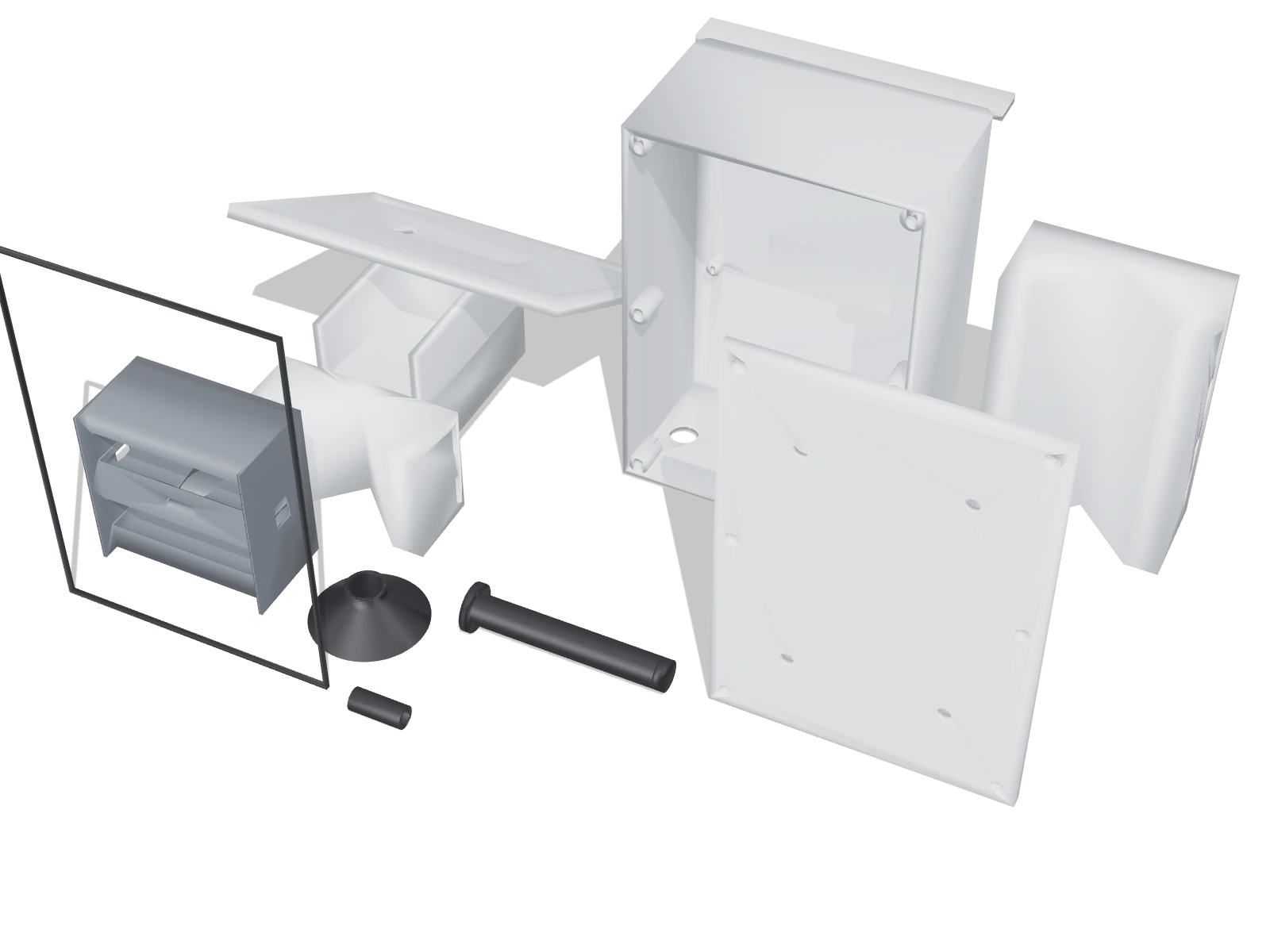
12 parts, generated from code and checked as closed solids. Pick a part to inspect it, or download the STL files to print.
See the CAD parts render
Loading the CAD…
Real CAD · drag to rotate · scroll to zoomReal CAD · swipe sideways
Bought hardware fitted inside this part (checked in the CAD: nothing collides with the plastic)
- Enclosure body (radar window, visor)enclosure-body.stl · ASA, white
- Back plateback-plate.stl · ASA, white
- Back-plate gasketlid-gasket.stl · TPU 95A
- Mic stalk with membrane seat (1/2 in OD)mic-stalk.stl · ASA, black
- Mic board retainermic-retainer.stl · ASA
- Rain hoodrain-hood.stl · ASA, black
- Battery cradle (2× 32700)battery-cradle.stl · ASA
- Pole/fence clamppole-clamp.stl · ASA, white
- Solar bracket (pilot)solar-bracket.stl · ASA, white
- QuietLight case (net post, e-paper window, light-pipe holes, CHECK IN key with ball guard)quietlight-case.stl · ASA, white
- QuietLight back with V-saddle for 38–76 mm net postsquietlight-back.stl · ASA, white
- QuietLight halo light pipequietlight-halo.stl · PETG, clear
Open risks we are working on
- Booking systems may not export a live feed; a manual weekly upload is the fallback
- Players may resent lights going off; the halo warns first, play heard counts as a check-in, and lights never go off inside a checked-in booking
- Quiet and standard paddles may have overlapping pitch for some models and balls; commissioning refuses a court that cannot separate them
- Players may read amber as an accusation; the screen never names anyone and the light never stops play
- Courts and councils may treat MEMS-mic data as weak evidence; the unit is not a type-approved IEC 61672 meter
- The pop classifier may confuse tennis or basketball impacts on shared courts
- Buyers may want only a one-off study, not a subscription
- LD2450's quoted 6 m range may miss the far corners of a court; BGT60TR13C is the fallback
Design stage only: nothing on this page is for sale. Specifications and prices are targets.