Drag to rotate · right-drag to move · scroll to zoom · click a part for its size and placeSwipe to rotate · pinch to zoom · two fingers to move · tap a part for its size
How it fits together
PickleQuiet, part by part
Scroll or tap a part. Press “See the 3D CAD design” to watch the model, built from our CAD, light each part up and show how it connects.
Real-time 3D render · drag to rotate · final design may varySwipe sideways to rotate
01
The whole PickleQuiet
A fence-mounted box measures court noise and counts paddle pops without storing audio, then sends signed hourly records over LTE-M to a dashboard.
02Brain
ESP32-S3-WROOM-1
The brain: it runs the picklequiet-fw program
03
IM69D130 microphone
Hears the courts through a weatherproof membrane on a stalk
ESP32-S3-WROOM-1 · PDM, 6-way cable · Digital audio bits
04
LD2450 radar
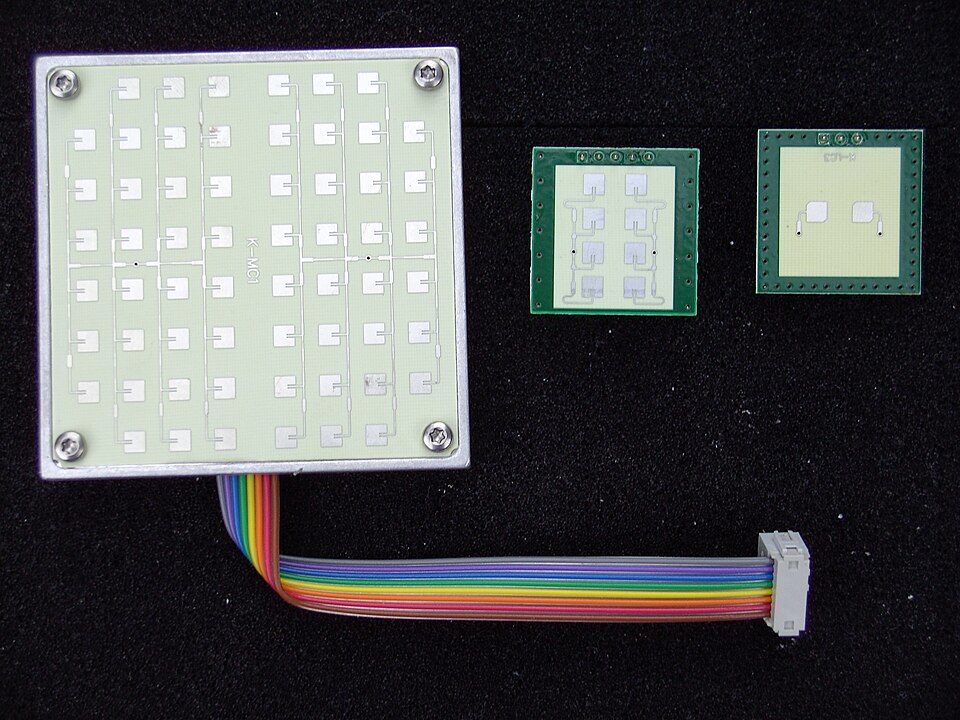
Sees where people stand on each court, with no images
ESP32-S3-WROOM-1 · UART, 256000 baud · Target x, y, speed
05
nRF9151 LTE-M modem
Sends records to the cloud over the mobile network
Charges the cells from a solar panel or 12 V supply
ESP32-S3-WROOM-1 · I²C and power rail · Charge status and power
07
Two LiFePO4 cells
Store 38 Wh so the box runs through the night
ESP32-S3-WROOM-1 · Charger and 3.3 V rail · Power
08
QuietLight net-post unit
Hears pops at one court and shows a green or amber light
XIAO ESP32-S3 · ESP-NOW radio · Pop levels per court
09
All connected
7 key parts, one program, and your phone
What it is
A solar pole unit that measures court noise and counts paddle pops without recording audio.
What it does
Counts paddle pops on the device
Checks quiet-gear hours court by court
Shares one record with neighbours
Shows which courts are in use
Who it's for
Parks departments, HOAs and clubs with courts near homes, and acoustic consultants.
How the parts connect
PickleQuiet, wired up
Every part, what links it to the brain, and how the data reaches your phone. A solid line is a cable; a dashed line is a radio link.
Drawn from the PickleQuiet parts list. The 3D view above is built separately, from the CAD.
The program
What controls PickleQuiet
Runs on
ESP32-S3-WROOM-1-N8R8
Written in
C on ESP-IDF v5 (FreeRTOS)
System
FreeRTOS tasks: audio, radar, agg, link, sys
AI model
Small decision-tree classifier for paddle pops
1Read 48 kHz audio into 1,024-sample buffers that are overwritten
2Weight A and C, then log levels each second
3Classify pop candidates by sound shape, not loudness
4Add a minute record; hash and sign it each hour
5Send records through the modem; keep 30 days if offline
picklequiet-fw.cppmain loop
void audio_task(void *arg) {
    for (;;) {
        i2s_channel_read(pdm_rx, buf, sizeof buf, &n, portMAX_DELAY);
        meter_update(buf, n);               // A/C weighting, Fast/Slow, LAeq
        if (pop_candidate(buf, n)) {        // 15 dB rise in under 3 ms
            pop_features(buf, &f);          // 1024-pt FFT, 21 ms window
            if (pop_classify(&f) == POP)
                minute.pops++;
        }
        if (second_elapsed()) minute_add(meter_snapshot());
        // samples are never copied out; the buffer is overwritten
    }
}
To your phone
How the data reaches PickleQuiet dashboard
Browser, plus email, SMS and webhooks
Fence unit
LTE-M · MQTT over TLS
Cloud
Web dashboard · email · SMS
Operator's phone
What you see in the app
One screen for each job PickleQuiet does.
10:00
PickleQuiet dashboardNoise record
Level over limit · 09:00–10:0010:00
LAeq 57 dBA at the property line, limit 55. 1,220 pops.
Last hour
57 dBA
Pops
1,220
Hourly LAeq at the property line (dBA)
Noise recordA neighbour says the courts are too loud. Owner and neighbour open the same hourly record of noise level and pop count, with no audio kept.
06:46
PickleQuiet dashboardCurfew pops
Curfew pops · Court 206:46
11 pops in 5 min before allowed hours.
Before 08:00
34 pops
Court
Court 2
Pops per 5 min, this morning (pops)
Curfew popsTwo players start hitting at 06:41, well before the 08:00 start. The unit counts the pops and tells the court manager.
19:24
PickleQuiet dashboardQuiet-gear hours
Court 2 · Loud paddle pops19:24
Court 2 amber: 23 loud pops since 19:00 in quiet-gear hours.
Courts green
3 of 4
Court 2
Amber
Courts, quiet-gear hours
Court 1
Court 2
Court 3
Court 4
Quiet-gear hoursFrom 19:00 to 21:00 only quiet paddles are allowed. Each net-post light stays green while pops are quiet, and turns amber when loud ones are heard.
18:10
PickleQuiet dashboardNo-show release
Court 3 released · 18:1018:10
No CHECK IN or play by 18:10. Lights off, court shown as free.
Courts in use
3 of 4
Light saved
50 min
17:55Court 3 lights on for booking
18:00Booking starts, no check-in
18:10Released · lights off
No-show releaseNobody turns up for the 18:00 booking on court 3. At 18:10 the booking is released, its floodlights go off and the court shows as free.
App screens with sample data. The interface is in development.
What the app gets
Data PickleQuiet sends to the app
Hourly noise level
LAeq 54.1 dB
Every hour
Paddle pops
1,220 pops
Every hour
Outside-hours alert
11 pops in 5 min
When it happens
Battery charge
82%
Daily
Courts in use
3 of 4 free
On change
No audio is stored or sent. The radar sends anonymous points, no images, and nothing names a player.
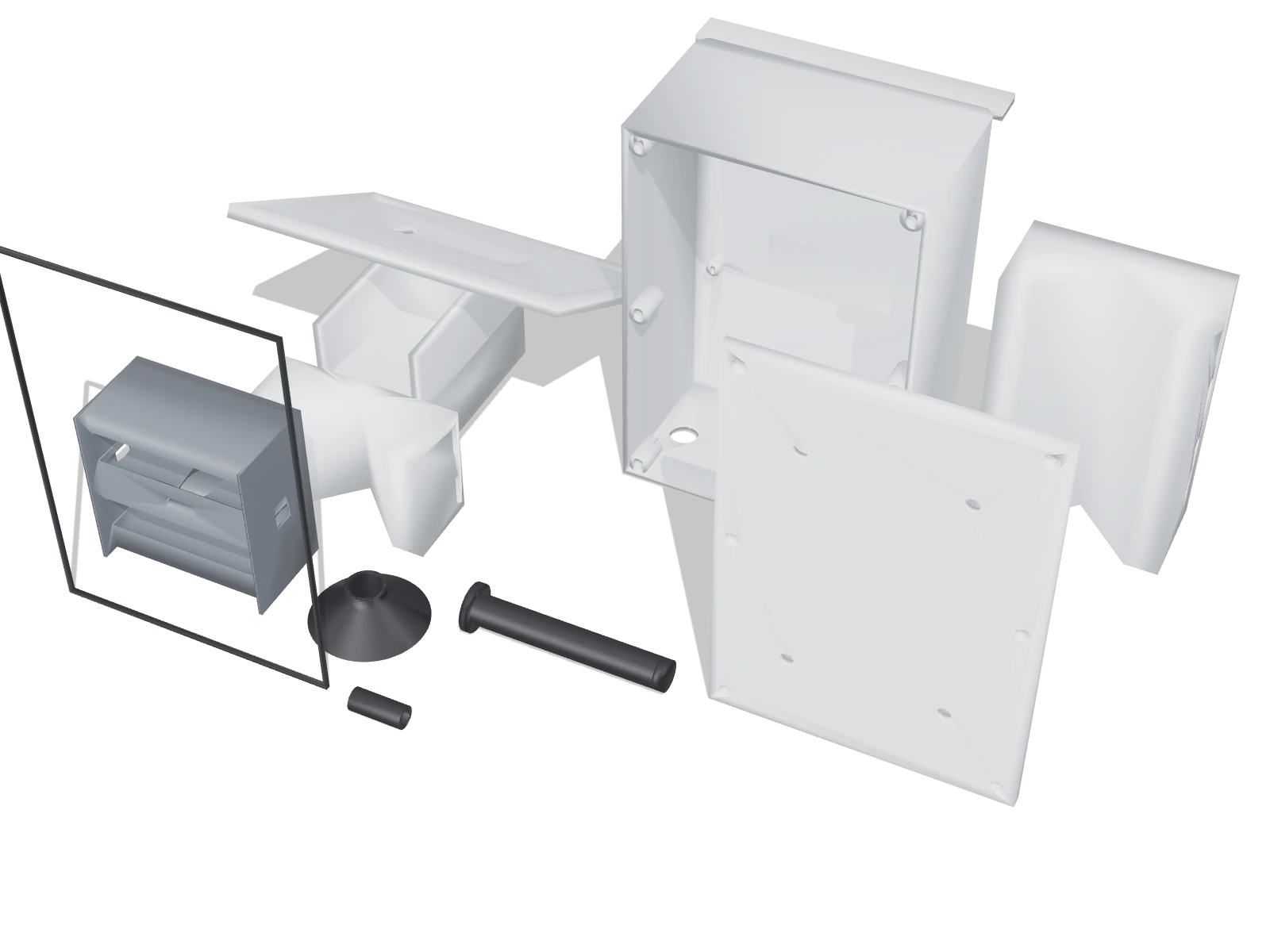
CAD design · Design complete (stages 1–6) + rev A2 QuietHours + rev A3 CourtLight, not built
Designed in code, checked in 3D
12 printed parts, each a single closed solid
Every bought part fitted inside and checked for collisions
Assembled exactly as shown in the 3D CAD view (the button on the picture at the top)
Infineon IM69D130 MEMS microphone (TDK T5838 second source) behind a GORE ePTFE membrane · Optional Hi-Link HLK-LD2450 24 GHz radar (no camera) · SHT40 humidity for condensation flags · Accelerometer for tamper events · QuietLight per court: SPH0645 I2S MEMS mic (pitch only), 1.54in e-paper, 12-LED halo · CHECK IN key per court: 16 mm IP67 ring-LED button; floodlight link: listed DIN-rail relay (Shelly Pro 2) on the contactor coil
Connectivity
LTE-M, MQTT over TLS, 30-day store-and-forward · ESP-NOW to CourtPulse satellites for extra courts · Webhook and iCal feed for booking systems
Power
10 W solar panel, TI BQ25798 MPPT and 2 × IFR32700 LiFePO4 (38 Wh): about 10 days without sun, 5 with the radar; optional 12 V DC input from a listed outdoor supply
Enclosure
3D-printed white ASA box with TPU gasket, black ASA mic stalk and rain hood, V-saddle clamp for 38–60 mm posts
Dimensions
Enclosure 124 × 83 × 173 mm; 1/2 in (12.7 mm) mic stalk
Ingress rating
IP65 (target, to be tested)
All target specifications
Acoustics
Acoustics target specifications
Type
Indicative monitor, designed toward IEC 61672-1 Class 2; not type-approved
Field accuracy
LAeq,1h within ±2 dB of a Class 1 meter in low wind
Lower limit
Readings below 40 dBA flagged
Metrics
LAeq, LCeq, LAFmax, LCpeak, L10/L50/L90, pops/min
Privacy and evidence
Privacy and evidence target specifications
Audio
21 ms RAM buffer only; never stored or sent
Spectral uplink
1/3-octave per minute
Records
Signed and hash-chained hourly
Drift check
94 dB calibrator over the stalk, ≤0.7 dB
Power and environment
Power and environment target specifications
Solar
10 W panel
Battery
38 Wh LiFePO4
Operating range
−10 to +60 °C
Targets for production units; they may change during development.
Pricing
Hardware: $699–$1,048per 4-court kit or fence unit
Software: $39 per month
Target pricing: CourtLight Kit $699 for 4 courts (4 QuietLights with CHECK IN keys + 2 floodlight relays; electrician extra), QuietLight $169 each. Fence noise unit $899 + $39/mo, or $1,200 per 60-day study rental. CourtPulse radar option +$149. Estimated BOM about $155 per fence unit with radar, about $55 per QuietLight and about $45 per court for the relay share (many prices unverified).
Indicative launch pricing in USD, excluding taxes and shipping. Final pricing is confirmed before any balance is charged.
Community
What do you think of PickleQuiet?
PickleQuiet is in development. Rate the idea, tell us what to change about the features, specs or price, and we'll build it with your feedback.
Parks, HOAs and clubs with courts near homes face several jobs on every court: neighbours complain about paddle noise and cities measure by hand at the fence (Cupertino limited hours in May 2026; Denver measured over 70 dB against a 55 dB limit; a Berwyn YMCA closed courts in a lawsuit), quiet-gear hours are posted on signs nobody checks, booked courts at $10–20 an hour sit empty (Tualatin Hills, Kino, Boulder), and rec play has no referee for score and line arguments. Our own two products for it cost $2,074 and $44 a month per court.
Combined into CourtPost (https://iemilabs.com/products/courtpost/); PickleQuiet itself is unchanged
Tennis and pickleball clubs and parks lose booked courts to no-shows and pay £4–7.20 an hour to light empty courts. Their rules void a booking if nobody checks in within 10 minutes (City of Edmonton, North Hudson WI) or 10–15 minutes (LTA ClubSpark clubs), but with no staff on site nobody knows who turned up, and lights tied to the booking stay on for the whole hour. Sources: Edmonton and North Hudson court rules, LTA ClubSpark club booking and floodlight pages, Warwick District Council.
Changed CAD part quietlight-case: a 16 mm CHECK IN key below the screen inside a raised guard ring so a ball cannot press it (15/15 fit checks, still one solid)
New court software: lights on 5 minutes before a booking, release and lights off at 10 minutes with no press and no play, amber warning before any switch-off, curfew honoured; 12/12 booking checks pass
New bought parts: a listed DIN-rail relay per two courts on the existing floodlight contactor, fitted by an electrician
BOM: about $4.50 per court light for the key and about $45 per court for the relay share (est.); target CourtLight Kit $699 for 4 courts
Product page, design page and DESIGN.md updated with the no-show and floodlight use cases, FAQs, sources and a rules note
Cities with pickleball courts beside homes now set quiet-gear hours but cannot check them: Laguna Beach requires quiet paddles at Lang Park with rangers enforcing, Cupertino asks for USA Pickleball Quiet Category paddles and balls from dawn to 9 am and 7–9 pm with signs only, and Carmel-by-the-Sea banned play because quiet gear "would have required monitoring" (city notices, Spectrum News, Fox News, USA Pickleball).
New CAD part: QuietLight case for each net post, with an e-paper screen facing the court, a microphone port with a waterproof membrane and 12 light holes; 12 of 12 fit checks pass
New CAD parts: back cover with a V-shaped clamp seat for 38 mm square to 76 mm round net posts (9 of 9 fit checks), and a clear light pipe that glows green or amber (12 of 12)
New court logic: pops judged by pitch, counted only on the court that heard them loudest, amber after 5 minutes of mostly loud pops, one count to the park after 15 minutes; 11 of 11 replayed checks pass
BOM: about $50 per court light (est.); product page updated with quiet-gear hours, new FAQs on legality and how it tells paddles apart
No. PickleQuiet is a concept in the in-house design and testing stage. The design and CAD are complete, but nothing has been built or validated, and all specifications are targets.
What happens if we forget to press CHECK IN?
If the QuietLight hears you playing (at least 10 pops in 5 minutes on your court) or the optional radar sees you on court, that counts as checking in. The court is only released if there is no press and no play by 10 minutes after the start.
Can the lights go off while we are playing?
Not inside a checked-in booking. They go off 5 minutes after your booking ends, after an amber flash, or at the curfew the venue sets. The club's own timer or switch stays fitted as the fallback, and CourtLight is not a safety device.
Does it work with our booking system?
It needs a calendar feed of bookings per court. Many systems can export one, but not all; the first pilots will be with clubs whose system does. If yours cannot, a weekly upload is the fallback.
Who fits the floodlight relay?
A qualified electrician, inside your existing lighting panel. The relay is a bought, listed DIN-rail unit that switches the contactor coil, not the lamps. Nothing we 3D-print carries mains.
Does the QuietLight decide if a paddle is legal?
No. Only USA Pickleball's Quiet Category list says which paddles and balls are quiet-certified, and the rulebook governs play. The QuietLight only shows whether loud pops dominate a court during the hours a park sets. It never calls a fault, stops play, names anyone or issues a fine; rangers or the club decide.
How can it tell a quiet paddle from a loud one?
By pitch. Quiet Category paddles pop lower (the first certified one is below 600 Hz) than typical paddles (around 1 kHz). Each court is commissioned with both kinds, and if the two cannot be told apart at a court it says so instead of guessing.
Does it record conversations?
No. Audio exists only in a 21 ms memory buffer that is constantly overwritten. The firmware has no way to store or send audio, and the audio module will be open-sourced so anyone can check.
Is it a certified sound level meter?
No. It is an indicative monitor designed toward IEC 61672-1 Class 2 targets and checked per unit against a Class 1 reference. It is not type-approved, and reports never say 'certified' or 'compliant'.
Can it tell pickleball from tennis?
It tries, but tennis on shared courts is the main confusion risk. The classifier will be tuned on field data, and sites can tag courts as mixed use.
Can we rent it for one study?
Yes, that is planned: a $1,200 rental for 60 days on the same hardware, with a 24-hour co-location against a Class 1 meter at the start.
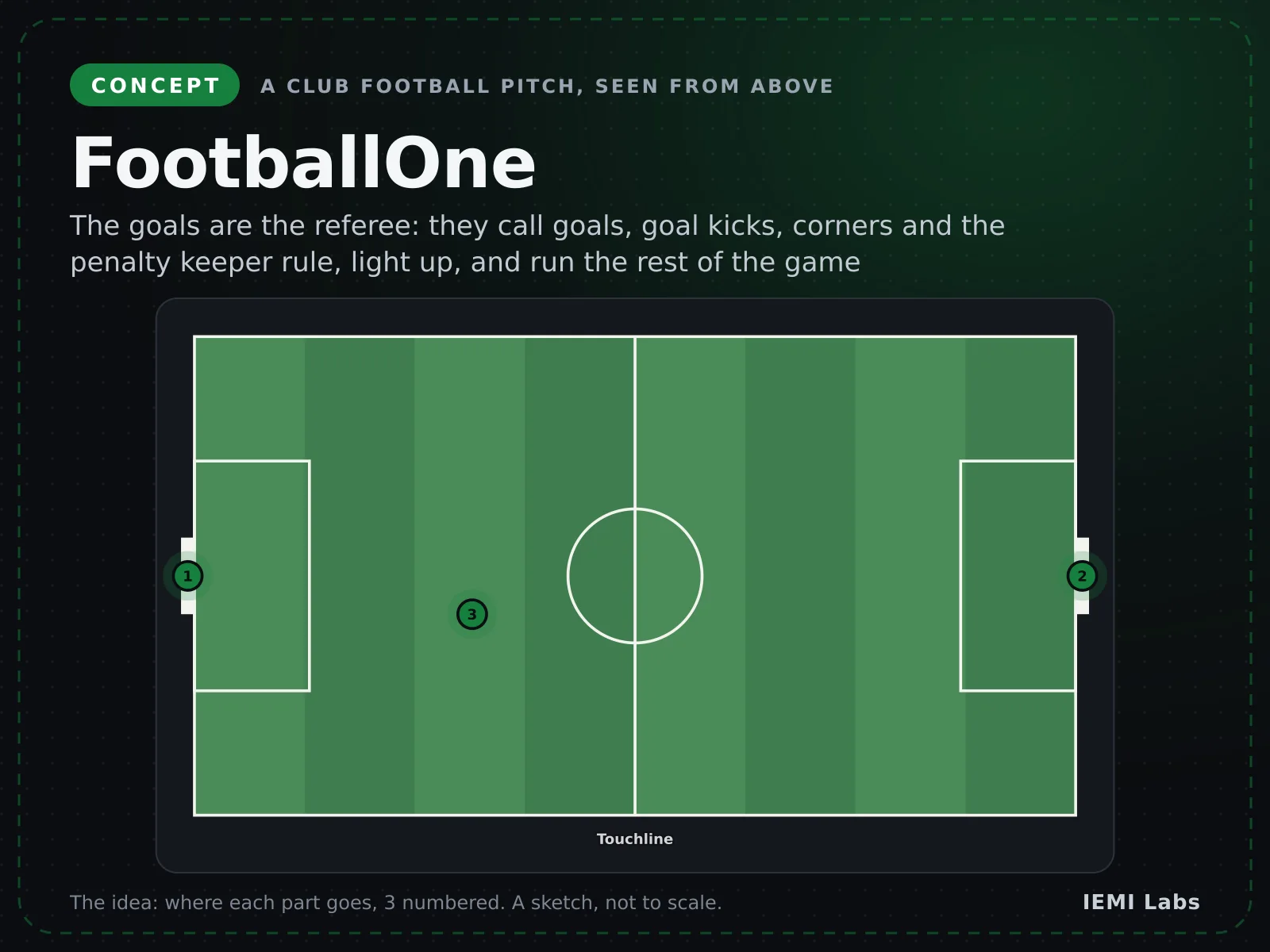
IEMI's one football product: a pair of legal full-size goals with cameras, computers, batteries and radios inside the posts and crossbar, and a referee wrist unit.
Sees the ball cross the line and buzzes the referee
Logs shots, saves and headers at goal
Counts the keeper’s 8 seconds and keeps the match clock and sin bins
From$4,690per pair of smart goals with sockets and the referee wrist unit