CallNote
The call cord every nursing-home bed already has, made smart: the carer's phone gets the reason and a voice note, and the resident sees 'Help is coming'
A replacement call handset that plugs into the existing 1/4" nurse-call jack. Every key still calls the old way (dome light, station, tone). Each key also carries a reason (HELP, TOILET, PAIN, DRINK), holding a key records a short voice note, the right person's phone gets the reason, and the resident's e-paper screen says 'Help is coming' when a carer accepts. A handset that falls to the floor is reported. It adds information to a call; it never replaces the call system.
- Who buys it
- Directors of nursing and administrators of US nursing homes and assisted living on older 2-wire 1/4"-jack call systems (light and tone only). Today they use a $6-18 call cord; a new system costs about $450-3,000 per room.
- Why it pays
- Sending the right role with the right item saves an estimated 1.0-2.2 staff-hours a day on a 30-bed unit (est.), against $450-3,000 per room to replace the call system. The home also gets a response-time log for complaints and surveys.
- Target price
- $99 per handset + $4 per bed per month; Edge Hub $299 per site or shared (target)
- First-minute wow
- A resident holds TOILET and says 'I need to go now'; the aide's phone shows 'Room 7 · TOILET · I need to go now' while the old dome light comes on as usual, the aide taps Coming, and the handset buzzes and shows 'Help is coming'.
What the research found
And how this design answers it
- A call light says someone needs something, not what (toileting is the top reason) → 4 reason keys route TOILET and DRINK to aides and PAIN to the nurse, saving 1.0-2.2 staff-hours a day per 30 beds (CAD route report, est.)
- Reason keys exist only on proprietary hospital pillow speakers (20-pin, 8-pin DIN) → CallNote uses the 1/4" plug older nursing-home systems and bed alarms already use, with a DIN adapter option
- Residents get no feedback and staff forget to return (over 3% in a 4-home study) → 'Help is coming' on e-paper with a buzz, escalation if nobody accepts, re-alert if an accepted call is not closed
- The call must never depend on new electronics → every key has its own plain loop switch beside the MCU switch; a flat battery leaves a working call cord
- Call lights out of reach or on the floor are a common F558 finding → an accelerometer sees 12-21 samples of free fall from any bed height (CAD drop report) and tells the aide, plus a rail cradle
- Voice-only assistants fail residents who cannot speak → keys first, voice optional, the clip always playable next to the transcript
Use case
Night shift on a 30-bed unit, 2 aides and 1 nurse
ResidentCare aideNurseDirector of nursing
- 01Trigger: at 02:40 Room 7 holds TOILET and says 'I need to go now'; the dome light comes on as before
- 02Detection: the handset's MCU switch gives the reason and records the note; the Edge Hub transcribes it on site
- 03Alert: the aide's phone shows 'Room 7 · TOILET · I need to go now'; the aide taps Coming and the handset shows 'Help is coming'
- 04Action: a PAIN call from Room 12 goes straight to the nurse, and a handset that slid to the floor in Room 4 is put back before it is needed
Outcome: The right role answers first with the right item, residents know help is coming, and the DON sees response times by reason (est.)
How it works
Architecture
- 01
Sense: 4 keys with 2 switches each (loop + MCU), PDM mic, LIS3DH accelerometer, battery voltage
- 02
Decide: the XIAO ESP32-S3 sets the reason, records a held-key note and detects a drop; the Edge Hub applies routing and escalation rules
- 03
Send: the old loop calls as before; Wi-Fi MQTT/TLS to the site Edge Hub, audio stays on site, the cloud gets counts and device health only
- 04
Tell: carer phone alerts with reason and clip/transcript, the handset's e-paper and buzz, and a weekly response report for the DON
Hardware
Real parts, buyable today
Bill of materials: about $62 per handset at qty 1, about $30 at qty 1,000 (est.).
| Block | Part | Why this part |
|---|---|---|
| MCU + mic | Seeed XIAO ESP32S3 Sense (camera not fitted) | Wi-Fi, PDM mic, PSRAM for a 10 s clip, about 14 µA deep sleep (est.) |
| Keys | 8 x Omron B3F tact switches under a 1-piece TPU keypad | Two switches per key: one closes the old loop, one tells the MCU |
| Feedback | Waveshare 1.54" e-paper + coin vibration motor | 'Help is coming' stays on screen with no power |
| Drop sense | Adafruit LIS3DH | Free-fall interrupt; 12-21 samples from any bed height |
| Power and cord | 1800 mAh LiPo + 2.4 m cord with Switchcraft 280 1/4" plug | 110-560 days per charge (est.), same plug as the cord it replaces |
Mechanical
Printable CAD
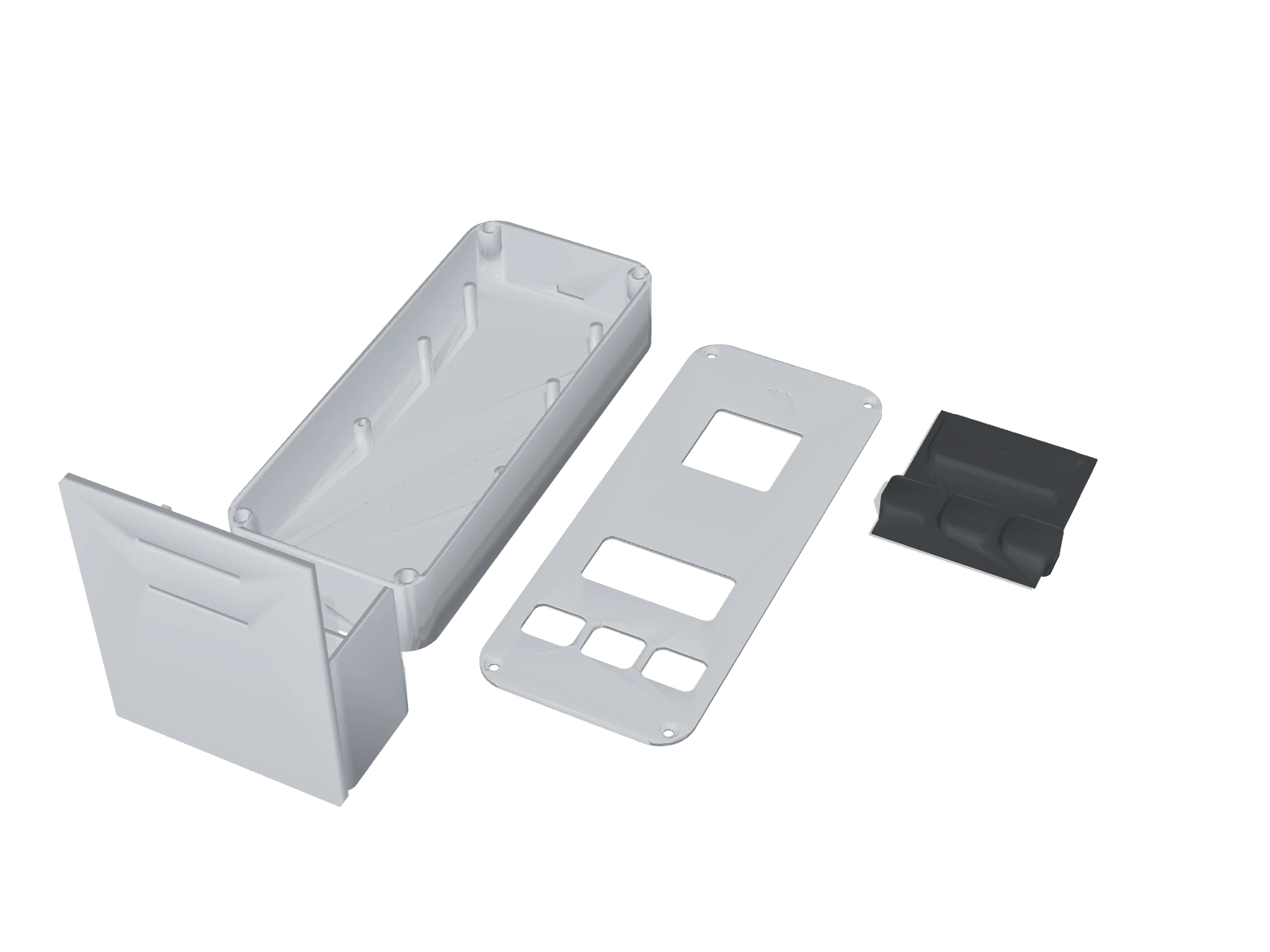
4 parts, generated from code and checked as closed solids. Pick a part to inspect it, or download the STL files to print.
See the CAD parts render
Loading the CAD…
Real CAD · drag to rotate · scroll to zoomReal CAD · swipe sideways
Bought hardware fitted inside this part (checked in the CAD: nothing collides with the plastic)
- Handset shell: battery bay, keypad PCB standoffs, display posts, XIAO bay with USB-C opening, cord strain-relief blockhandset-shell.stl · PETG
- Handset lid: 4 key openings, display window, mic holes, counterbored screwshandset-lid.stl · PETG
- Keypad: one TPU piece, 4 caps on a web, tactile dot on HELPkeypad.stl · TPU
- Rail cradle: holds the handset upright at the bed rail with the keys exposed, cord slot, strap platerail-cradle.stl · ASA
Open risks we are working on
- UL 1069: a third-party cord may affect a listed system, and some states require listed components (gate R1: NRTL and 3 AHJs)
- FDA classification [UNVERIFIED]: nurse-call products use IQA, OUG or KMI codes (gate R2); no fall or outcome claims
- Not every 1/4" system is a simple contact (resistor-coded or cord-out jacks); test 5 systems (gate G2)
- Rauland, Hillrom/Baxter, Tektone and Ascom sell reason keys on new systems; our window is the old system's remaining life
- Voice clips are PHI; staff may see response reports as surveillance (unit-level by default, gate G3)
- No director-of-nursing interviews yet (gate G1: 10 interviews + a 2-week unit pilot)
Design stage only: nothing on this page is for sale. Specifications and prices are targets.