GaugeEye
One battery camera that reads a whole panel of analog gauges
One battery or solar camera reads up to 6 analog dials in its view, such as a pump-station gauge board or a boiler front, and sends the numbers (not images) every 15–60 minutes over LoRaWAN or LTE-M.
- Who buys it
- Small water and wastewater utilities with unmanned lift stations, wells and booster stations, and chief engineers of boiler and chiller rooms (non-hazardous areas only).
- Why it pays
- Fewer truck rolls to read remote gauges: about $28–43k/yr for 10 stations against about $5.9k in year 1 (est., visit count unvalidated). Boiler-log transcription is about $7.3k/yr per plant room (est.).
- Target price
- $399 per camera (LoRaWAN), $449 (LTE-M), $479 (solar + LTE-M), + $12/camera/month for up to 6 dials (target)
- First-minute wow
- Clip one camera on a pipe, tap each dial's centre, min and max on your phone, and a whole panel goes digital.
What the research found
And how this design answers it
- Single-meter AI nodes already sell for $96 → one 5 MP wide view covers up to 6 dials, bringing the price per dial to $67–133, with tap-to-calibrate setup
- Camera dev boards sleep at about 3 mA → custom board powers the whole ESP32-S3 + camera domain to 0 V between reads; sleep target ≤ 12 µA
- Li-SOCl₂ cells cannot supply camera and LED pulses → Tadiran HLC-1520A pulse buffer, LED pulses capped
- Long arms resonate → short serrated-rosette arm (69 or 118 mm), short exposure, 3-frame median and drift-tolerant registration
- Glare, sun and night → flared hood, cross-polarised 850 nm IR flash, and a quality gate that holds a bad read instead of sending it
- No independent accuracy figure exists → no accuracy claim until the bench test passes (95% of reads within ±2% FS on 8 gauges)
Use case
Remote lift station without the daily drive
Utility operatorOperations superintendentGaugeEye (LTE-M)IEMI cloud
- 01Trigger: every 15 minutes the camera wakes and reads the two pump discharge gauges and the wet-well level gauge
- 02Detection: the cloud converts readings to psi and ft and sees pump 1 discharge below 8 psi for 2 reads while pump 2 is normal
- 03Alert: the on-call operator gets a text flagging a possible air-lock or worn impeller, with the 24 h trend
- 04Action: the operator decides whether to roll a truck; the superintendent exports the monthly CSV
Outcome: 96 readings a day per gauge instead of one visit, and trucks roll only on exceptions; about $28–43k/yr saved across 10 stations (est.)
How it works
Architecture
- 01
Sense: OV5640 5 MP autofocus camera with 2× 850 nm IR LEDs behind a polarised hood
- 02
Decide: classical CV on the ESP32-S3 reads each dial's needle direction, value and confidence (no neural network in v1)
- 03
Send: RAK3172 supervisor sends numbers over LoRaWAN US915 (or nRF9151 over LTE-M), then sleeps
- 04
Tell: IEMI cloud converts to units, runs per-dial rules and sends SMS, email or webhook alerts and shift-log reports
Hardware
Real parts, buyable today
Bill of materials: about $139 per camera (LoRaWAN), $161 (LTE-M), $122 (solar LoRaWAN) at qty 1 (est.).
| Block | Part | Why this part |
|---|---|---|
| Supervisor + LoRaWAN | RAK3172 (STM32WLE5) | Always-on RTC and radio at microamp sleep; switches the vision domain on only for reads |
| Vision MCU | ESP32-S3-WROOM-1-N16R8 | 8 MB PSRAM for UXGA frames; BLE + Wi-Fi for phone setup |
| Camera | OV5640 autofocus, no IR-cut filter | Focus set once at install; sees 850 nm flash at night |
| Power | 2× Tadiran TL-5930 D cells + HLC-1520A, TPS22918 switches, TPS63802 buck-boost | 38 Ah with pulse support and 0 V vision domain between reads |
| LTE-M option | Nordic nRF9151 | Remote sites without LoRaWAN coverage |
| Solar option | Voltaic P126 2 W panel + 2× IFR26650 LiFePO4 | About 100 days autonomy at 5-minute reads (est.) |
Mechanical
Printable CAD
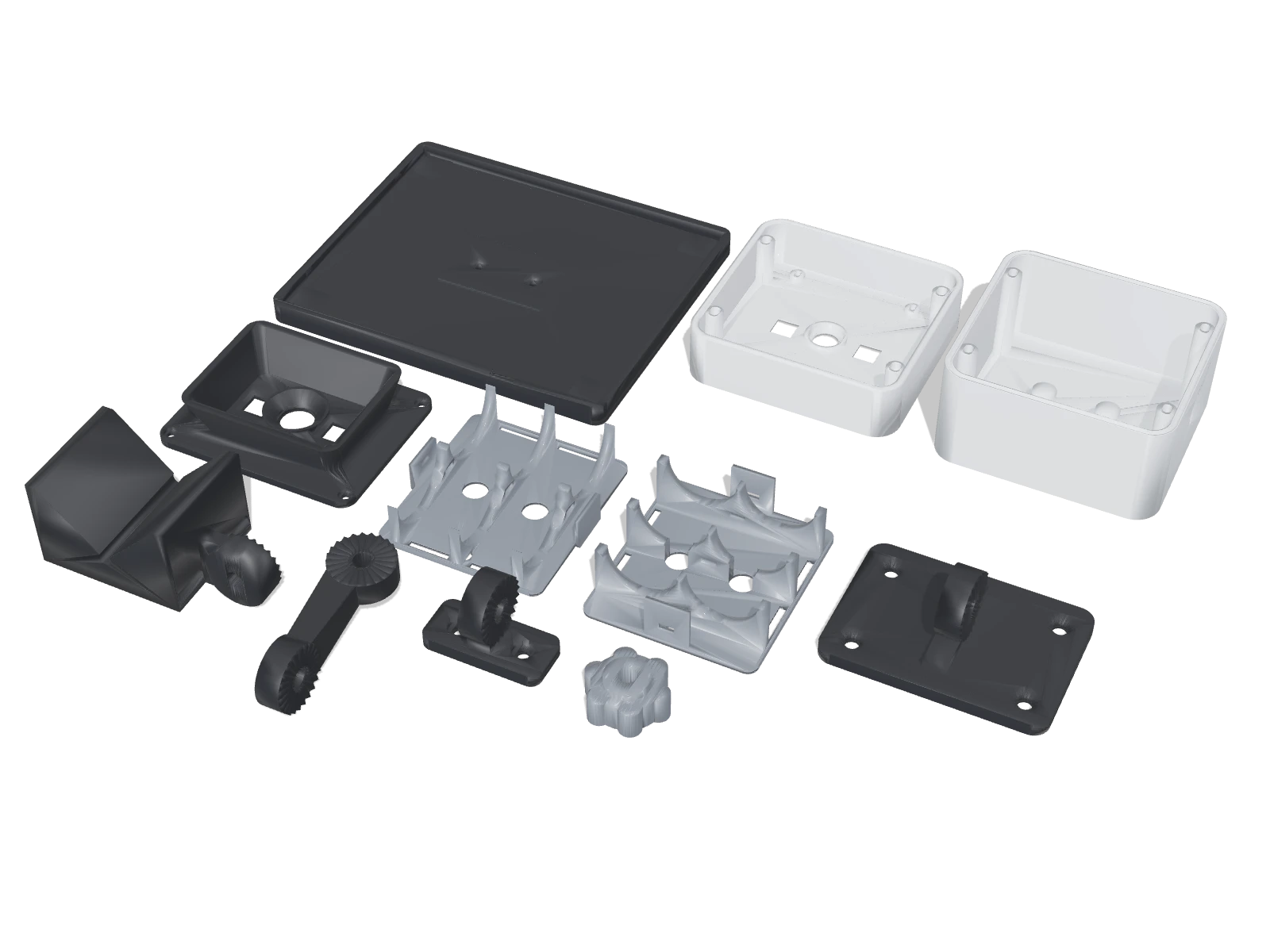
11 parts, generated from code and checked as closed solids. Pick a part to inspect it, or download the STL files to print.
See the CAD parts render
Loading the CAD…
Real CAD · drag to rotate · scroll to zoomReal CAD · swipe sideways
Bought hardware fitted inside this part (checked in the CAD: nothing collides with the plastic)
- Front shell with lens and IR windowsfront-shell.stl · ASA, white (PETG indoors)
- Back shellback-shell.stl · ASA, white
- Lens hoodlens-hood.stl · ASA, black
- D-cell battery sledbattery-sled-d.stl · PETG
- LiFePO4 battery sled (solar)battery-sled-lfp.stl · PETG
- Back knuckleback-knuckle.stl · PA-CF or ASA
- Rosette arm segmentarm-segment.stl · PA-CF (ASA for pilots)
- Pipe clamp (25–60 mm OD)pipe-clamp.stl · ASA
- Wall / unistrut bracketwall-bracket.stl · ASA
- Solar panel traysolar-tray.stl · ASA, black
- Joint knobjoint-knob.stl · PETG
Open risks we are working on
- Reading accuracy across 6 dials in one wide view (parallax, glare, red needles under IR) is unproven until the bench test
- Power is estimated, not measured; publish "about 3 years at 15 minutes" until measured
- A 2-segment ASA arm may resonate near 30 Hz pumps (est.); use 1 segment or PA-CF on pump skids
- HLC-1520A availability is a supply risk
- Class I Div 2 / ATEX areas are out of scope for v1
- Long utility sales cycles; pilot kit kept under a p-card limit (about $1.4k est.)
Design stage only: nothing on this page is for sale. Specifications and prices are targets.