DiamondOne
IEMI's one product for baseball and softball: a smart home plate and three smart bases that call balls and strikes, force outs and fair or foul, keep the count and pitch counts, and still measure every pitch in the cage, in one app
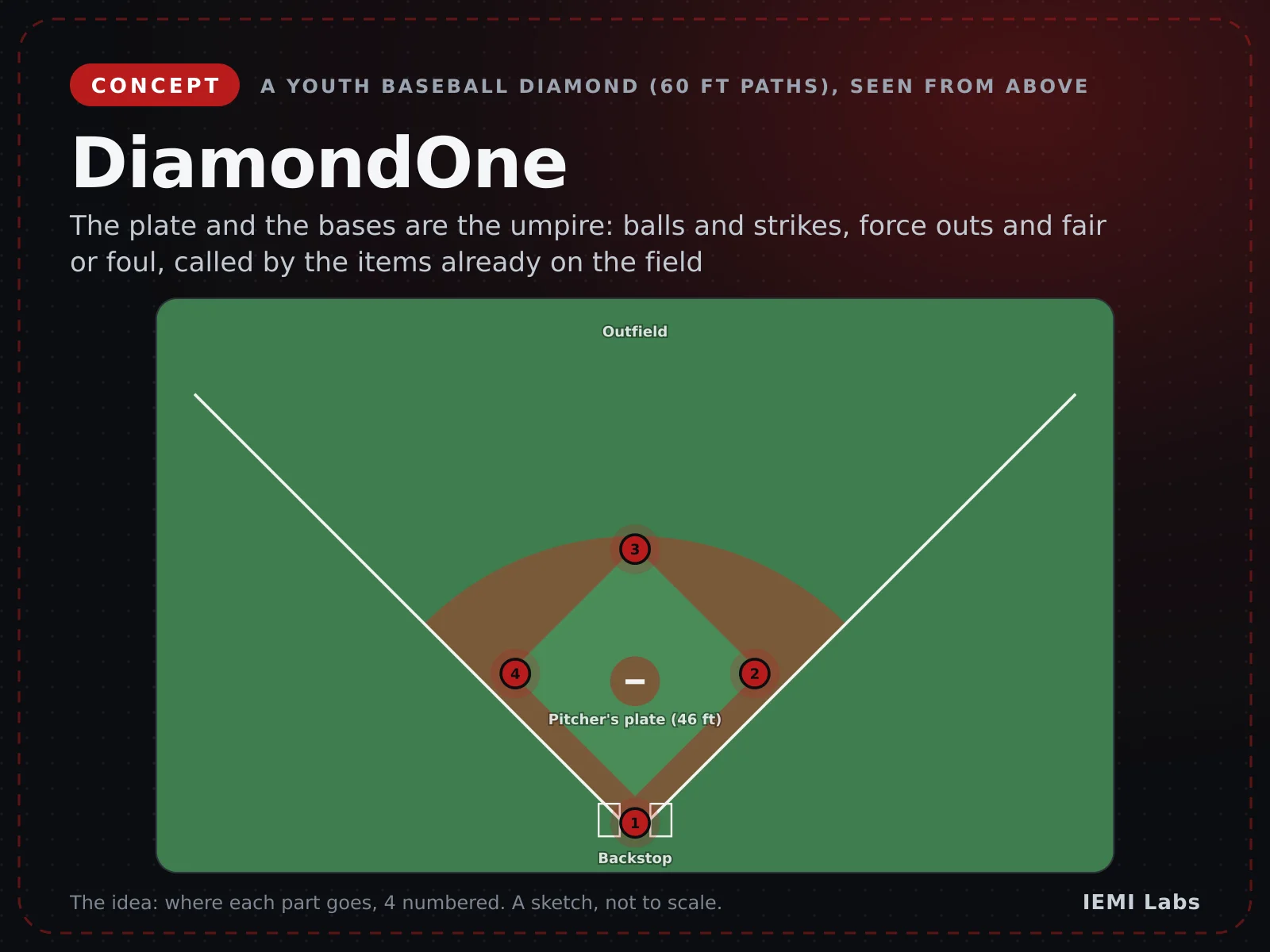
The home plate and three bases the field already uses, at their legal size on the same anchors, are the umpire: the plate calls balls and strikes from a camera looking up the zone and measures every pitch with its radar; each base calls force outs from its foot sensors, camera and mic, and first and third call fair or foul down the line. Every call lights up on the item with a tone, is signed inside it, and reaches one app with the count, score and pitch counts. In a cage lane the same plate measures pitch speed, location and machine drift.
- Who buys it
- Youth leagues, rec leagues, schools and clubs that cannot book enough umpires (about $15 to $85 an umpire a game), and batting-cage facilities that want pitch numbers in every lane.
- Why it pays
- $1,990 a set + $29/month per field instead of $4,178 + $138/month for CageTrax, LengthLock Kit and a CoachVision bay bought separately, plus a plain plate and bases (about $480 to $580) and umpire fees of $15 to $85 an umpire a game.
- Target price
- $1,990 per set (home plate and three bases) + $29/month per field (target)
- First-minute wow
- A 2-1 pitch just catches the outside edge: before the catcher stands up, the plate glows green and the scorer's phone says strike, 1.4 cm inside, 2-2; on the next play first base glows red: out by 40 ms.
What the research found
And how this design answers it
- Rev O (28 Oct 2026): the equipment was re-checked: an L-screen cannot officiate a game, so DiamondOne is now the home plate and the three bases, at OBR 2.02 and 2.03 size on the field's own anchors
- Plate: Pi Zero 2 W brain, AI camera looking straight up the strike zone, front camera and OPS243-A radar facing the pitcher, call light, tone, ATECC608 and tamper switch, 4 cells
- Each base: XIAO ESP32-S3 Sense camera and mic, four foot sensors under the cover, call light, tone, ATECC608 and tamper switch, 2 cells
- Calls alone in club play: balls and strikes, force outs, fair or foul at first and third, pitch count, count and score; tags assist; unsure means unsure
- Camera views checked in the CAD for every call; nothing added to the field
- Cage lanes keep pitch speed, location and machine drift from the same plate; swing distance, replay and lane watch are listed as gaps
- Flagship (27 Oct 2026): one product for baseball and softball folds CageLane, CageTrax and CoachVision Bay
Use case
A 12U rec game with no umpire
CoachesScorer (a parent)Players
- 01Trigger: no umpire turns up; the coaches pick No official on the scorer's phone
- 02Detect: the plate sees each pitch cross the zone; the bases feel each foot and hear each glove pop
- 03Act: strikes and balls light the plate, outs and fouls light the bases, each with a tone; two close plays come back unsure and the coaches agree them from the clip
- 04Log: the count, score and both pitchers' pitch counts are signed and in the app
Outcome: The game starts on time, the calls are consistent for both teams, and every argument has a clip
How it works
Architecture
- 01
Sense: a zone camera, a front camera and a radar in the plate; a camera, a mic and four foot sensors in each base
- 02
Decide: each base makes its own calls on its ESP32-S3; the Pi Zero 2 W in the plate calls balls and strikes and keeps the game
- 03
Send: BLE Secure Connections from the bases to the plate; Wi-Fi with TLS from the plate to the app
- 04
Tell: the call light and tone on the item, and one app for the scorer, coaches, parents and the cage desk
Hardware
Real parts, buyable today
Bill of materials: $1,018 of parts per set at qty 1 (bom.csv, prices checked 28 Oct 2026); about $1,430 built and shipped at qty 1, about $1,000 at qty 100 (est.).
| Block | Part | Why this part |
|---|---|---|
| Brain | Raspberry Pi Zero 2 W (SC0510) in the plate | Runs the zone camera, the radar, the game and the app link on about 3.6 W with the front camera and radar (est.) |
| Zone camera | Raspberry Pi AI Camera (SC1174) | Ball detection on the sensor, looking straight up the zone |
| Pitch radar | OmniPreSense OPS243-A-CW-RP | Every pitch speed and the pitch count |
| Base cameras | 4 x Seeed XIAO ESP32-S3 Sense | Front camera in the plate, camera and mic in each base |
| Foot sensors | 12 x Adafruit 1075 force sensors | The moment a foot touches the bag |
| Security | 4 x ATECC608 + Omron D2F-01 tamper switches | Every call signed inside the item that made it |
Mechanical
Printable CAD
4 parts, generated from code and checked as closed solids. Pick a part to inspect it, or download the STL files to print.
Loading the CAD…
Real CAD · drag to rotate · scroll to zoomReal CAD · swipe sideways
Bought hardware fitted inside this part (checked in the CAD: nothing collides with the plastic)
- Smart home plate (brain, zone camera, front camera, radar, light and cells inside)home-plate.stl · cast aluminium tub with a moulded whitened rubber top, flush windows
- Smart first base (camera, mic, foot sensors, light and cells inside)first-base.stl · rubber-covered moulded shell, foam fill, white cover, Ø38 anchor stem
- Smart second basesecond-base.stl · rubber-covered moulded shell, foam fill, white cover, Ø38 anchor stem
- Smart third basethird-base.stl · rubber-covered moulded shell, foam fill, white cover, Ø38 anchor stem
Open risks we are working on
- Dirt on the plate windows hides the ball: the plate says unsure, and the umpire or catcher brushes the plate as usual (test D-O1)
- BLE from inside a base at ground level over 26 m is unproven; ESP-NOW long range is the fallback (test D-O2)
- Force outs closer than one frame rely on the glove pop and the foot sensors; plays under 50 ms are unsure by design
- Cleats and slides on the windows: sapphire-faced, recessed 0.5 mm, tested (D-O3)
- Not an approved system for sanctioned games: assists only there
- Hawk-Eye, Trackman or base makers could build the same
Design stage only: nothing on this page is for sale. Specifications and prices are targets.