IEMI Edge Hub + VisionCam
Eight cameras, one quiet box, no video leaves the building
One quiet on-site box takes up to 8 camera streams and some sensor nodes, runs detection locally and sends events, not video; several IEMI app packs run on it, starting with LotWatch (free spaces and overstays for small parking lots).
- Who buys it
- Property managers and owner-operators of 20–150 space lots (LotWatch), small warehouses (dock pack) and MachineState shops (shop-floor vision add-on).
- Why it pays
- No per-camera cloud video fees or uploads: under 100 MB/month backhaul instead of about 3–5 TB/month for cloud video. For a LotWatch site, manager time and recovered visitor spaces come to about $2.6k–6k/yr (est., unverified).
- Target price
- LotWatch: $1,190 installed kit + $39/site/month (proposal, demand test needed)
- First-minute wow
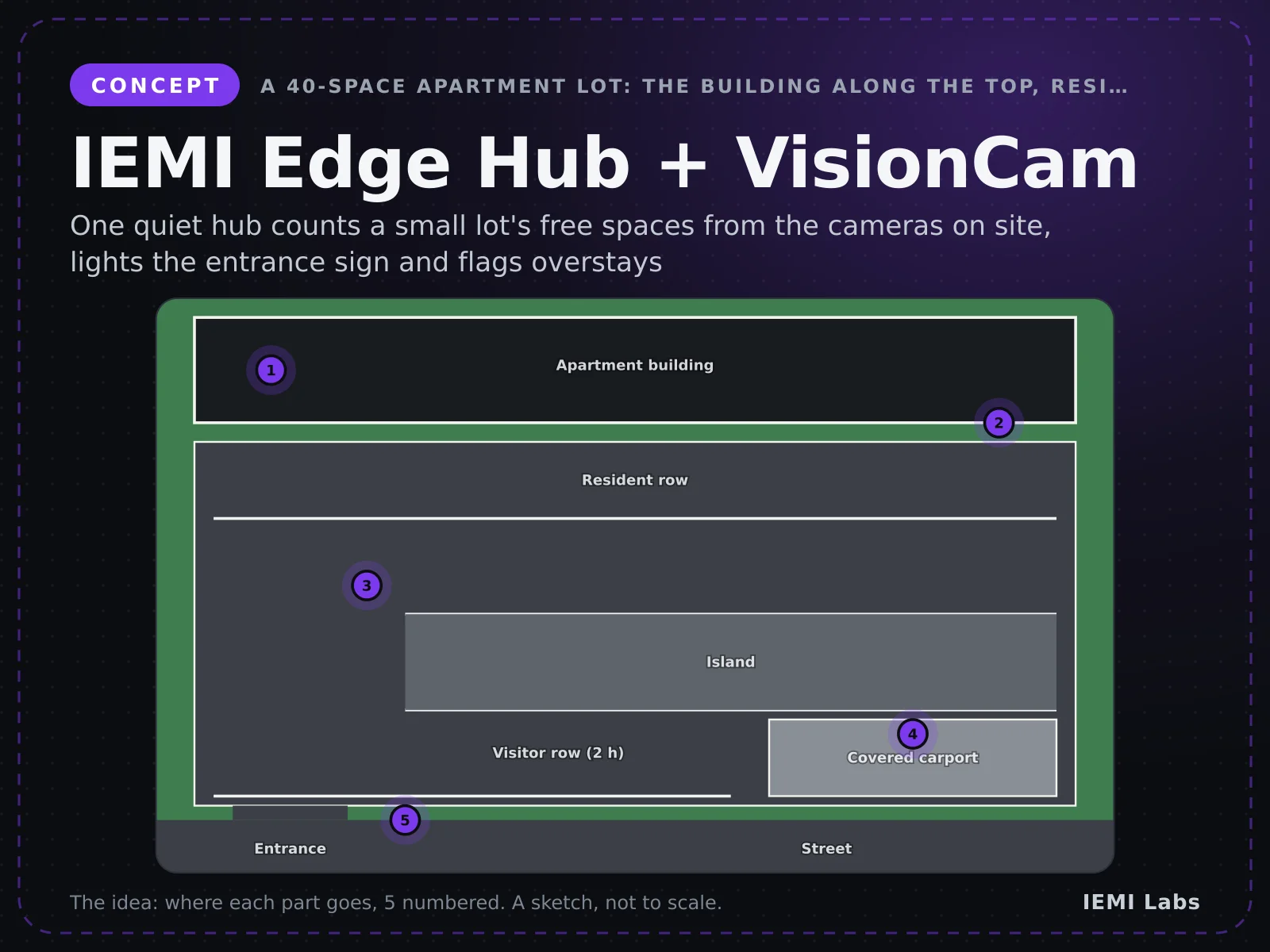
- A live free-space count ("VISITOR 3 · RESIDENT 11") on an LED sign at the entrance and on residents' phones, with no images leaving the site.
What the research found
And how this design answers it
- Enterprise vision is costly and cloud-heavy → Pi 5 + Hailo-8 hub with a core cost of about $285, events only, one hub for several app packs
- Enterprise parking guidance is priced for big operators → uses 2–4 existing or $40–60 ONVIF cameras, no per-space sensors
- A one-person lab can't support custom camera hardware at scale → buy ONVIF PoE cameras for outdoors; build a ~$30 VisionCam only for indoor or cable-less spots
- Pi 5 has no H.264 hardware decoder → detection runs on 640×360 substreams; main streams are only stream-copied into a RAM ring
- Internet outages blind cloud systems → counting, the sign and the local phone page keep working; events queue for 24 h or more
- Passing cars and occlusion cause false counts → hysteresis on per-space scores; occluded spaces are held, then reported unknown, never free
Use case
LotWatch: overstay in a 2-hour visitor space
Clinic or hotel front deskProperty managerDriver who overstaysEdge Hub + cameras
- 01Trigger: a 2-hour visitor space stays continuously occupied past its limit plus a 10-minute grace
- 02Detection: the hub's occupancy logic raises an overstay with space ID, start time, duration and one cropped snapshot (plates blurred by default)
- 03Alert: the cloud rules engine sends SMS/WhatsApp to the front desk
- 04Action: staff check, place a notice or call the guest, and acknowledge in the app; LotWatch provides evidence only and never calls a tow truck
Outcome: Visitor spaces stay available for visitors, with a time-stamped log for any dispute; about $1,500–4,000/yr per site (est.)
How it works
Architecture
- 01
Sense: up to 8 bought ONVIF PoE cameras or VisionCams on an isolated camera LAN, plus sensor nodes over the hub's Wi-Fi AP
- 02
Decide: YOLOv8n on the Hailo-8 NPU, then per-space occupancy with hysteresis and occlusion hold (LotWatch); dock and shop-floor packs reuse the engine
- 03
Send: about 1 KB events and 60 s summaries over MQTT to the shared IEMI rules server; under 100 MB/month
- 04
Tell: entrance LED sign and phone page from local MQTT, SMS/WhatsApp alerts, Monday occupancy report email
Hardware
Real parts, buyable today
Bill of materials: about $411 hub core, $496 with PoE switch; a typical LotWatch site (hub + switch + 4 Reolink + sign) about $745 (est.).
| Block | Part | Why this part |
|---|---|---|
| Compute | Raspberry Pi 5 8GB | Holds a 30 s main-stream RAM ring for 8 cameras plus containers |
| NPU | Raspberry Pi AI HAT+ 26 TOPS (Hailo-8) | Design target 8 streams × 10 fps YOLOv8n at 640 (unverified until bench test) |
| Camera LAN | TP-Link TL-SG1210P 8-port PoE+ switch + USB3 GbE adapter | Cameras physically separated from the uplink, with no internet |
| Storage | High-endurance microSD + Samsung T7 500 GB SSD | Event clips and the offline queue on USB3 |
| Outdoor camera | Reolink RLC-510A (bought, ONVIF PoE) | IR night vision, IP66 and a metal body for $40–60 |
| Indoor camera | VisionCam-W (Seeed XIAO ESP32S3 Sense) | About $30 for cable-less indoor spots and custom views |
Mechanical
Printable CAD
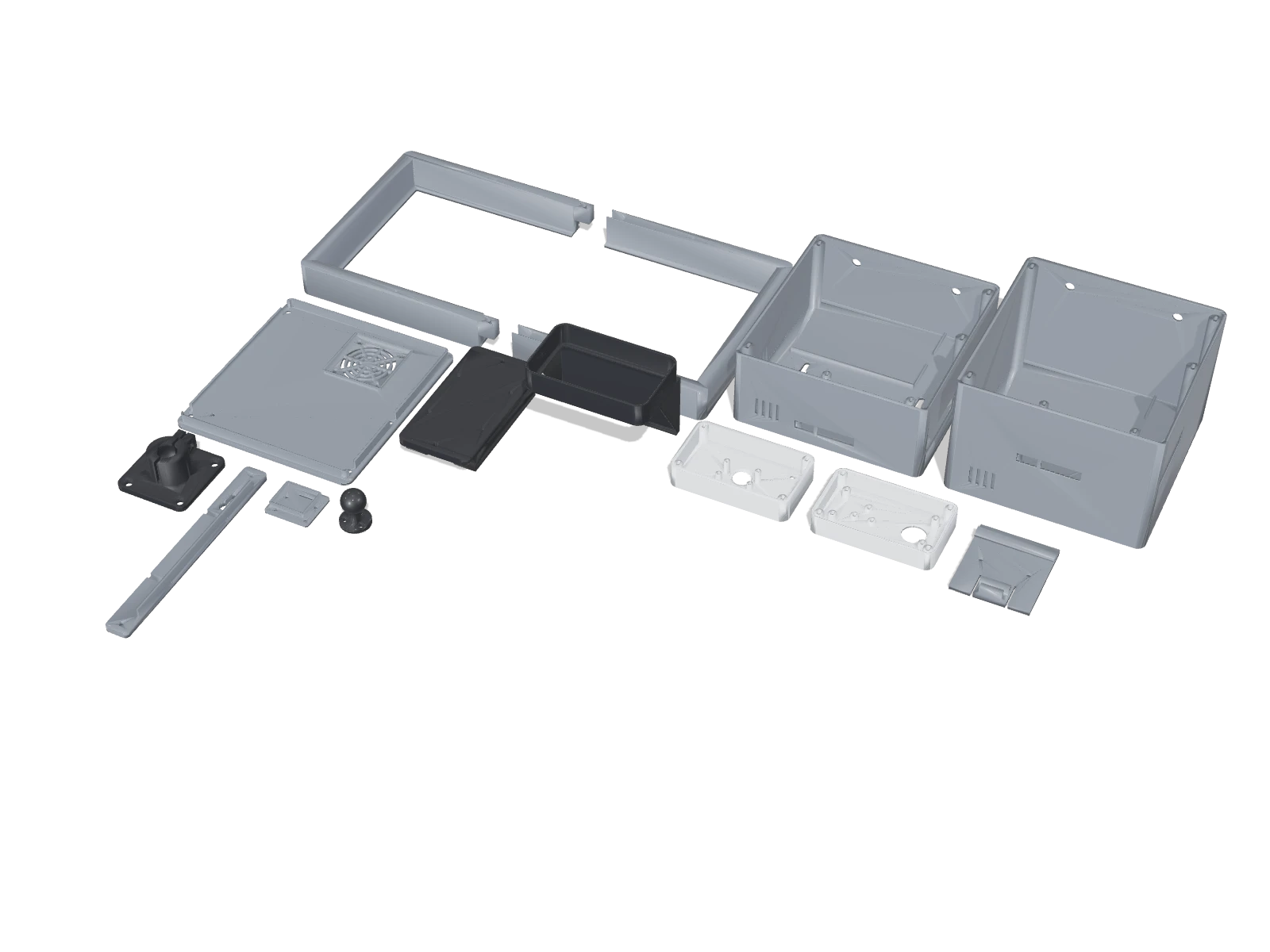
14 parts, generated from code and checked as closed solids. Pick a part to inspect it, or download the STL files to print.
See the CAD parts render
Loading the CAD…
Real CAD · drag to rotate · scroll to zoomReal CAD · swipe sideways
Bought hardware fitted inside this part (checked in the CAD: nothing collides with the plastic)
- Hub basehub-base.stl · PETG
- Hub base with UPS bayhub-base-ups.stl · PETG
- Hub lid with fan grillehub-lid.stl · PETG
- Hub DIN rail cliphub-din-clip.stl · PETG
- VisionCam frontcam-front.stl · ASA (outdoor) / PETG
- VisionCam backcam-back.stl · ASA / PETG
- VisionCam ball studcam-ball-stud.stl · PETG / ASA
- XIAO ESP32S3 camera carriercam-xiao-carrier.stl · PETG
- VisionCam wall mountcam-wall-mount.stl · ASA
- VisionCam outdoor hoodcam-hood.stl · ASA, black
- Pole bracket (40–100 mm)pole-bracket.stl · ASA
- LotWatch sign frame, leftsign-frame-left.stl · PETG
- LotWatch sign frame, rightsign-frame-right.stl · PETG
- LotWatch sign back bar (×2)sign-back-bar.stl · PETG
Open risks we are working on
- Night/IR occupancy accuracy may fall below the 97% target with COCO-trained YOLOv8n
- Pi 5 CPU-only H.264 decode may limit 8 streams
- The Hailo model compiler needs x86 Linux and Python; the lab is Node-only
- Optional plate reading has legal exposure: off by default, signage required, lawyer review before enabling
- Pi 5 secure boot is irreversible OTP with no TPM or TEE
- 2026 memory-driven price rises and Reolink firmware changes to ONVIF/RTSP; VisionCam IP65 is design intent, not certified
Design stage only: nothing on this page is for sale. Specifications and prices are targets.