SwitchRoom
One sensor on the electrical-room wall: hot panels, growing hot spots, dust build-up and room heat
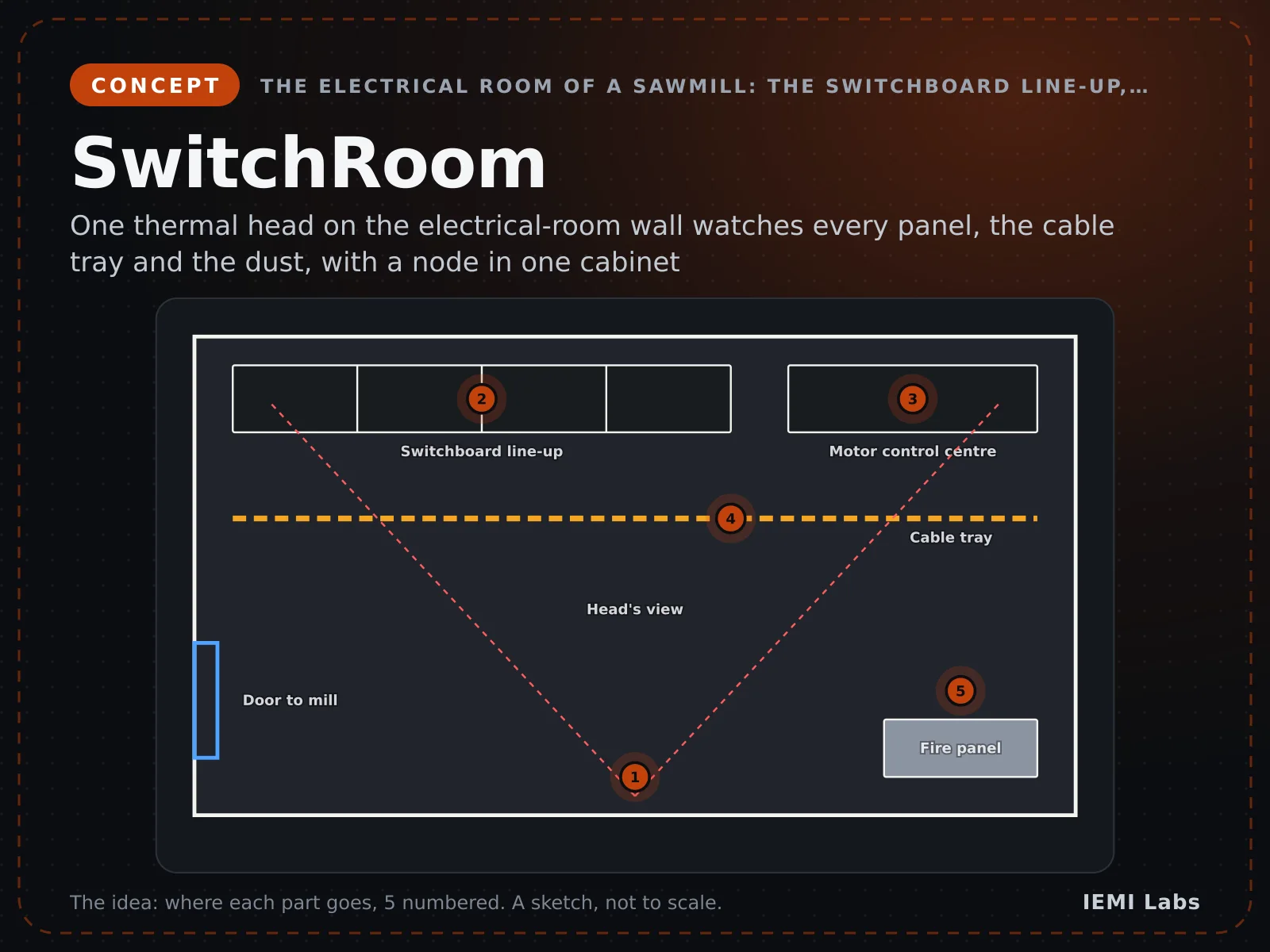
Does the jobs of PanelHeat AI, EmberWatch AI and DustWatch AI's dust monitor with one brain: a thermal head on the wall of a dusty plant's electrical or MCC room watches every breaker front, the cable tray and the floor for a hot spot that is growing, tracks the dust trend so cleaning happens before dust builds up on the gear, logs room heat, and collects a battery node inside the cabinet that reads the bare busbar joints.
- Who buys it
- Maintenance or plant manager of a sawmill, joinery, feed mill, recycling plant or other dusty site with one or more electrical rooms, often through their electrical contractor or thermographer.
- Why it pays
- $1,390 per room (head + one door node with 3 joint tags) + $29/month instead of $4,979 + $80/month for PanelHeat AI, EmberWatch AI and DustWatch AI bought separately (est.).
- Target price
- $1,390 per room (head + door node + 3 joint tags) + $29/room/month; extra door nodes $449 (target)
- First-minute wow
- One phone screen for the electrical room: 'MCC-2 feeder 4 is 9 °C hotter than its neighbours', 'dust 3.4 × last week, book a clean' and the busbar joint in section 2 rising, all from one box on the wall.
What the research found
And how this design answers it
- Three devices and three hubs in one room → one ESP32-S3 head on one PoE cable; its LoRa radio replaces the PanelSense hub
- EmberWatch needed an Edge Hub and a colour camera for vehicle masks → an electrical room has no vehicles, so the head runs the rise-rate tracker itself and masks people as warm shapes
- PanelSense's 32 x 24 array sees one cabinet → the 160 x 120 Lepton on the wall sees every breaker front in the line-up; the door node stays only for bare joints behind closed doors
- DustWatch's dust number could be read as a hazard reading → shown only as a trend against the room's own 7-day baseline, with the SHT40 mist flag
- Dust on the window blinds a thermal camera → EmberWatch's $0.25 HDPE film cartridge, a dust visor in the lid and a cowl that keeps the dust inlet facing down
- WetCheck's saw-water stations belong at the cutting bench, not in the electrical room → dropped from SwitchRoom and kept in DustWatch AI
Use case
Sawdust smouldering behind MCC-3 at 9 pm
Maintenance lead on callNight shift supervisorElectrical contractor
- 01Trigger: sawdust that has drifted under MCC-3 starts to smoulder against a hot cable gland after the day shift
- 02Detection: the Lepton tracks a floor spot rising 0.9 °C/min to 12 °C above its own baseline; the dust trend has been 3 × normal all week
- 03Alert: WARN to the on-call phone with a thermal still, then ALERT and the relay contact to SCADA when it keeps rising
- 04Action: the supervisor checks with a hand-held camera, isolates MCC-3 and clears the dust; the contractor re-terminates the gland next morning
Outcome: A smoulder found at hand-tool stage instead of a room fire, and the dust trend shows why cleaning moved from monthly to weekly (est.)
How it works
Architecture
- 01
Sense: FLIR Lepton 3.5 over the line-up, SPS30 dust trend, SHT40 room; door node with MLX90640 and RFID joint tags inside the cabinet
- 02
Decide: the ESP32-S3 tracks hot spots by rise rate, compares breaker zones with their peers and the dust with its 7-day baseline
- 03
Send: PoE Ethernet, MQTT over TLS; LoRa from the door node; one supervisory dry contact
- 04
Tell: SwitchRoom app and contractor dashboard, SMS on ALERT, monthly room report for the NFPA 70B and housekeeping records
Hardware
Real parts, buyable today
Bill of materials: about $327 head + $286 door node + $45 for 3 tags = about $660 per room at qty 1 (est.).
| Block | Part | Why this part |
|---|---|---|
| Brain | ESP32-S3-WROOM-1-N8R8 + W5500 + Silvertel Ag9905 PoE | One cable, about 2 W, enough to track a 160 x 120 thermal frame |
| Thermal camera | FLIR Lepton 3.5 (500-0771-01) behind an HDPE film window | Reused from EmberWatch; sees the whole line-up from 3 m |
| Dust | Sensirion SPS30 in its own chamber behind a dust cowl | Reused from DustWatch/WetCheck; relative trend only |
| Room | Adafruit SHT40 (4885) | Room heat and the mist flag |
| Radio | RAK3172 LoRa in the head and in the door node | Gets out of a steel cabinet; replaces the PanelSense hub |
| Door node | MLX90640 + M7E-HECTO reader + Saft LSH20, 3 AZN3254 joint tags | Reused from PanelSense for joints the camera can't see |
Mechanical
Printable CAD
7 parts, generated from code and checked as closed solids. Pick a part to inspect it, or download the STL files to print.
Loading the CAD…
Real CAD · drag to rotate · scroll to zoomReal CAD · swipe sideways
Bought hardware fitted inside this part (checked in the CAD: nothing collides with the plastic)
- SwitchRoom head casehead-case.stl · ASA
- Head lid with dust visorhead-lid.stl · ASA
- Film window cartridgewindow-cartridge.stl · PETG
- Dust inlet cowldust-cowl.stl · ASA
- 25° wall bracketwall-bracket.stl · ASA
- Door node case with magnetsnode-case.stl · PC-FR (pilot)
- Door node lid with lens hoodnode-lid.stl · PC-FR (pilot)
Open risks we are working on
- Not a fire detector or a listed device: early warning only, never wired to suppression; an AHJ may refuse the relay link
- A 160 x 120 camera from 3 m sees breaker fronts, not the joints behind them; closed panels still need the door node
- SPS30 fouling in sawdust or feed dust is unknown (kill criterion: fouls in under 2 weeks)
- Rise-rate false alarms from motors starting and doors opening are not measured yet
- Door-node install inside live gear needs a planned stop and a qualified electrician; some sites ban lithium cells in panels
Design stage only: nothing on this page is for sale. Specifications and prices are targets.