BedSide
Calls, turns, bed exit, night bag, room and hand rub at one bed
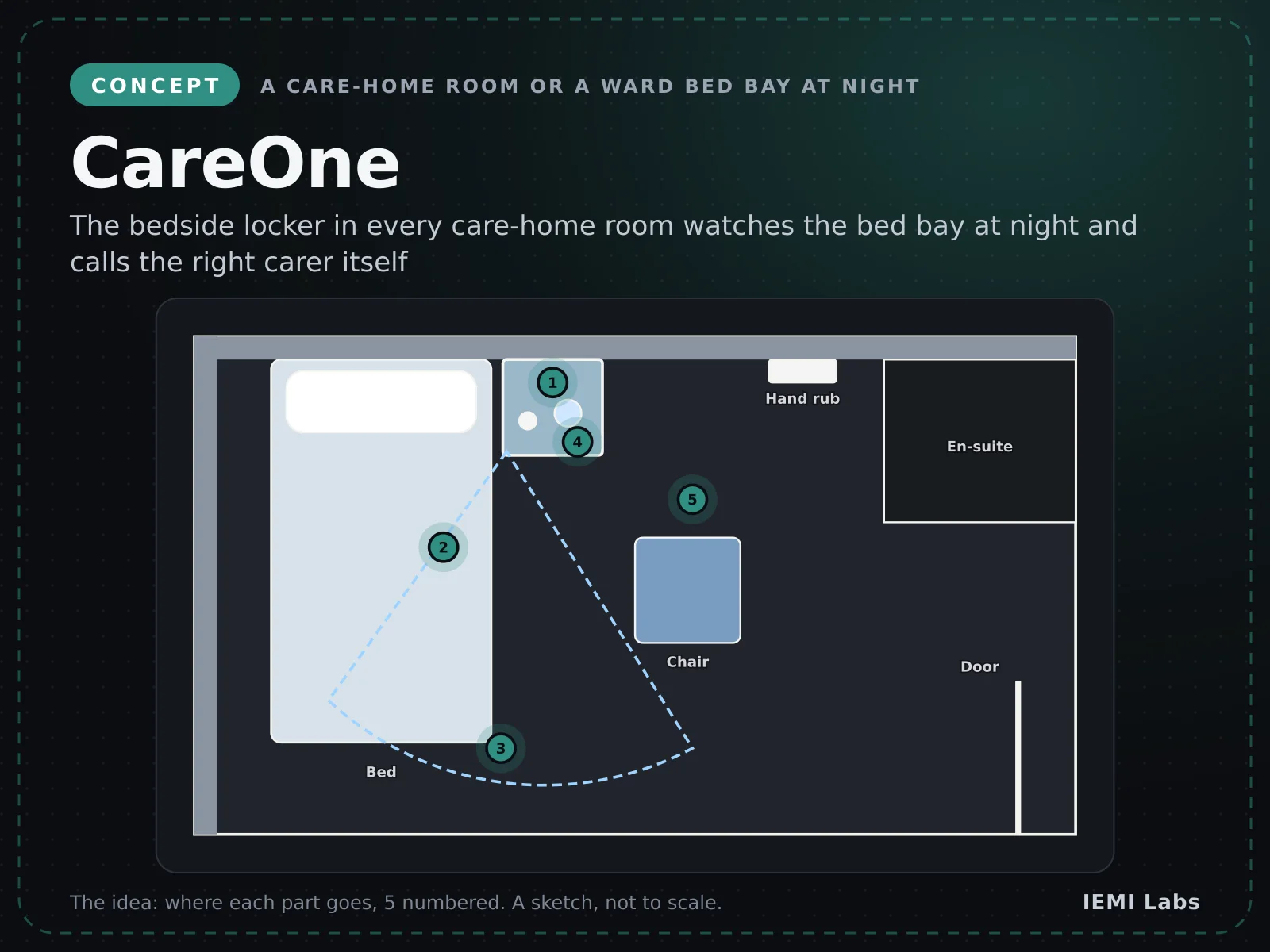
Does the job of CareWatch AI (room activity and time out of the room), TurnCup (turn reminders and bed exit), CallNote (call reason, voice note, Help is coming, dropped handset), BagPost (night-bag mL and no-drainage alert) and RubDock (hand-rub count and refill) with one ESP32-S3 hub on the footboard.
- Who buys it
- The director of nursing or manager of a care home or nursing home (US assisted living and nursing homes, UK care homes) who has to show turning charts, output charts, call response and hand-hygiene audits for every room.
- Why it pays
- Per bed, our five single-job products cost about $985 + $36 a month together; BedSide is $449 + $14 a month. One hub, one power plug and one app instead of five devices, four batteries to charge and five apps (est.).
- Target price
- $449 per bed + $14/bed/month (target)
- First-minute wow
- At 02:10 the resident presses TOILET: the night carer's phone says "Room 7, TOILET" with the voice note, the handset glows green, and the same screen already shows the last turn, the bag at 640 mL and that hands were rubbed on the last visit.
What the research found
And how this design answers it
- Five products at one bed meant five chips, four batteries and five apps → one ESP32-S3 hub on the footboard reads everything by wire; only the Dock at the door keeps a small radio chip
- CareWatch's 60 GHz puck and RubDock's door counter → one 24 GHz tracking radar in the hub: the cups already know in-bed, so the radar only has to see people in the room and visits to the bed
- CallNote's handset lost its battery, chip and screen → a wired keypad with a green "Help is coming" light; the call loop is still plain copper to the wall jack
- BagPost's 470 mm stand tipped at 4-10 N and pulled on the catheter → the same load cell in a hook strapped to the bed frame
- Hand-rub per room entry (RubDock) → hand-rub per bedside visit, closer to "before touching the patient"
Use case
A night in room 7
ResidentNight carerDirector of nursingBedSide hub
- 01Turn: at 22:30 the TurnClock and the carer's phone say a turn is due; the cups see the side change and reset the clock
- 02Rub: the Dock sees 1 g leave the dispenser just before the radar sees the carer reach the bed
- 03Call: at 02:10 the resident holds TOILET and says "I need to go now"; the phone gets the reason and the note; the handset glows green on Accept
- 04Out of bed: the cups see the bed empty and the radar sees nobody in the room for 26 minutes against a usual 8; the carer is told to check
- 05Bag: at 04:00 nothing has drained for 3 h; the carer is told to check the catheter tube
Outcome: One device kept the turning chart, the output chart, the call log and the hand-rub audit for room 7, and sent the carer only where needed (est.)
How it works
Architecture
- 01
Sense: 4 load-cell cups, a bag hook, a 24 GHz radar, the call handset and the Dock at the door
- 02
Decide: one ESP32-S3 in the footboard hub runs all five jobs with each resident's own baseline
- 03
Act: the TurnClock screen, the handset light and buzz, and carer phone alerts
- 04
Tell: one app and a station board with calls, turns, output, room activity and hand rub
Hardware
Real parts, buyable today
Bill of materials: about $326 per bed at qty 1 and about $150 at qty 100 (est.).
| Block | Part | Why this part |
|---|---|---|
| Brain | ESP32-S3-WROOM-1-N8R8 on a carrier with 5 x HX711 | Enough pins and memory for 5 scales, radar, handset and screen; Wi-Fi and ESP-NOW |
| Bed | 4 x TurnCup caster cups (16 x 50 kg cells) | Turns, bed exit and in-bed movement from weight |
| Room | Hi-Link HLK-LD2450 24 GHz radar | Tracks up to 3 people: activity, visits, empty room |
| Call | CallNote keypad with TCA9534, NeoPixel Jewel, mic, LIS3DH | Reason, voice note, Help is coming, dropped handset |
| Bag | TAL220B 5 kg cell in a bed-frame hook | Night bag mL without a stand that tips |
| Door | RubDock Dock (TAL220B + XIAO ESP32-C3) | Rub count and refill, by radio to the hub |
Mechanical
Printable CAD
13 parts, generated from code and checked as closed solids. Pick a part to inspect it, or download the STL files to print.
Loading the CAD…
Real CAD · drag to rotate · scroll to zoomReal CAD · swipe sideways
Bought hardware fitted inside this part (checked in the CAD: nothing collides with the plastic)
- Footboard hub case (radar window, cable glands)hub-case.stl · ASA
- Hub lid (TurnClock window, ACK and TURNED)hub-lid.stl · ASA
- Caster cup base (x4)cup-base.stl · PETG
- Caster cup top (x4)cup-top.stl · PETG
- Caster cup pad (x4)cup-pad.stl · TPU
- Call handset shellhandset-shell.stl · PETG
- Call handset lid (light window)handset-lid.stl · PETG
- Keypad (HELP, TOILET, PAIN, DRINK)keypad.stl · TPU
- Bed-rail cradlerail-cradle.stl · ASA
- Bag-hook clamp (bed frame)bag-clamp.stl · PETG
- Bag hook (on the load cell)bag-hook.stl · PETG
- Hand-rub Dock basedock-base.stl · PETG
- Hand-rub Dock hangerdock-hanger.stl · PETG
Open risks we are working on
- The footboard radar sees less of the room than CareWatch's ceiling puck, and the bathroom puck is dropped: "out of the room" is inferred from an empty bed and an empty room, to prove in a pilot
- I2C and the mic over a 2.5 m handset cord are unproven; the call loop itself never depends on them
- UL 1069 status of a third-party call cord (CallNote gate R1) and the medical-device boundary of bag alerts (BagPost gate R1) still apply; monitor and alert only
- One hub is a single point of failure for five jobs; it keeps about 15 h on its backup cell (est.) and the call loop works with the hub dead
- Nurse-call and bed makers (Hillrom, Rauland, Linet) can bundle; we win only by fitting the bed and call system the home already has
Design stage only: nothing on this page is for sale. Specifications and prices are targets.