CoolerCheck
Walk-in cooler and freezer faults found before the food is lost
Tells a kitchen and its refrigeration contractor what is going wrong with a walk-in (door open, failed or stuck defrost, short-cycling, compressor trouble, power loss) early enough that the fix is a daytime visit instead of a dumpster of food.
- Who buys it
- The refrigeration contractor, who resells, installs and watches a fleet dashboard; the user is the independent restaurant.
- Why it pays
- Expected walk-in trouble cost for a cooler + freezer site falls from about $1,617/yr with no monitoring (or $915/yr with a $149 threshold alarm) to about $376/yr (est., failure rates unverified). The contractor earns about $12k/yr gross margin per 45 sites (est.).
- Target price
- $199 site kit (gateway + 2 pucks) + $39 per CT node + $12/site/month, contractor wholesale (target)
- First-minute wow
- Every alert names a fault class with a suggested cause (for example "suspected defrost failure") and a 24 h chart, instead of a bare temperature number.
What the research found
And how this design answers it
- Temperature sensors are a commodity → every alert is a named fault class with a suggested cause, sold through contractors bundled with their service
- Contractor resale is unproven → white-label fleet dashboard, evidence charts they can bill from, IEMI handles billing
- Defrost causes false alarms → product probe in a glycol bottle drives alerts; the cloud learns the defrost schedule and the CT node confirms compressor off
- Radio through a steel walk-in → electronics outside the box, probes through the door gasket, 915 MHz LoRa to the gateway, LTE-M backhaul
- Batteries sag in the cold and bake on the roof → puck battery stays at kitchen temperature; CT node uses a −60…+85 °C Li-SOCl₂ cell in white ASA
Use case
Failed defrost at 2 am
OwnerKitchen managerRefrigeration technicianCoolerCheck cloud
- 01Trigger: the freezer's 02:00 defrost timer fails and ice builds on the coil
- 02Detection: the cloud sees no defrost in the learned window, then a second miss at 08:00, with the cycle minimum creeping up and compressor duty up 34%
- 03Alert: the technician gets a P2 ticket "suspected defrost failure" with a 24 h chart; the owner gets "Freezer OK for now, contractor notified"
- 04Action: the technician books a 10:00 visit at the normal rate, defrosts the coil and replaces the timer
Outcome: No product lost; about $4,800 of stock and a $158 emergency premium avoided (est.)
How it works
Architecture
- 01
Sense: two DS18B20 probes (air + glycol product) and a door reed on a puck outside the box; optional CT clamp node on the condensing unit
- 02
Send: 915 MHz LoRa (AES-128-CTR + CMAC) to a gateway in the office, then MQTT over TLS on LTE-M
- 03
Decide: cloud learns each box's defrost schedule, duty and starts/h, then runs rules R1–R10
- 04
Tell: SMS, voice, push and email by escalation ladder; white-label contractor dashboard and owner app with temperature logs
Hardware
Real parts, buyable today
Bill of materials: about $49 per puck, $46–51 per CT node and $91 per gateway at qty 1–10; about $22 / $35 / $62 at 500 pcs (est.).
| Block | Part | Why this part |
|---|---|---|
| Radio + MCU (all three devices) | RAK3172 (STM32WLE5 + SX126x) | One radio part everywhere keeps cost and firmware simple; LoRa reaches the office through kitchen walls |
| Puck power | 2× Energizer L91 + TPS610994 boost | About 1.6 mAh/day; battery stays outside the cold box |
| CT node power | Saft LS14500 Li-SOCl₂ + TPS7A0230 LDO | Rated −60…+85 °C for a rooftop condensing unit |
| Gateway | ESP32-S3-WROOM-1 + Quectel BG95-M3 LTE-M | No restaurant Wi-Fi needed |
| Gateway backup | BQ24074 power path + 18650 | Keeps reporting for at least 24 h through a power cut and detects mains loss |
Mechanical
Printable CAD
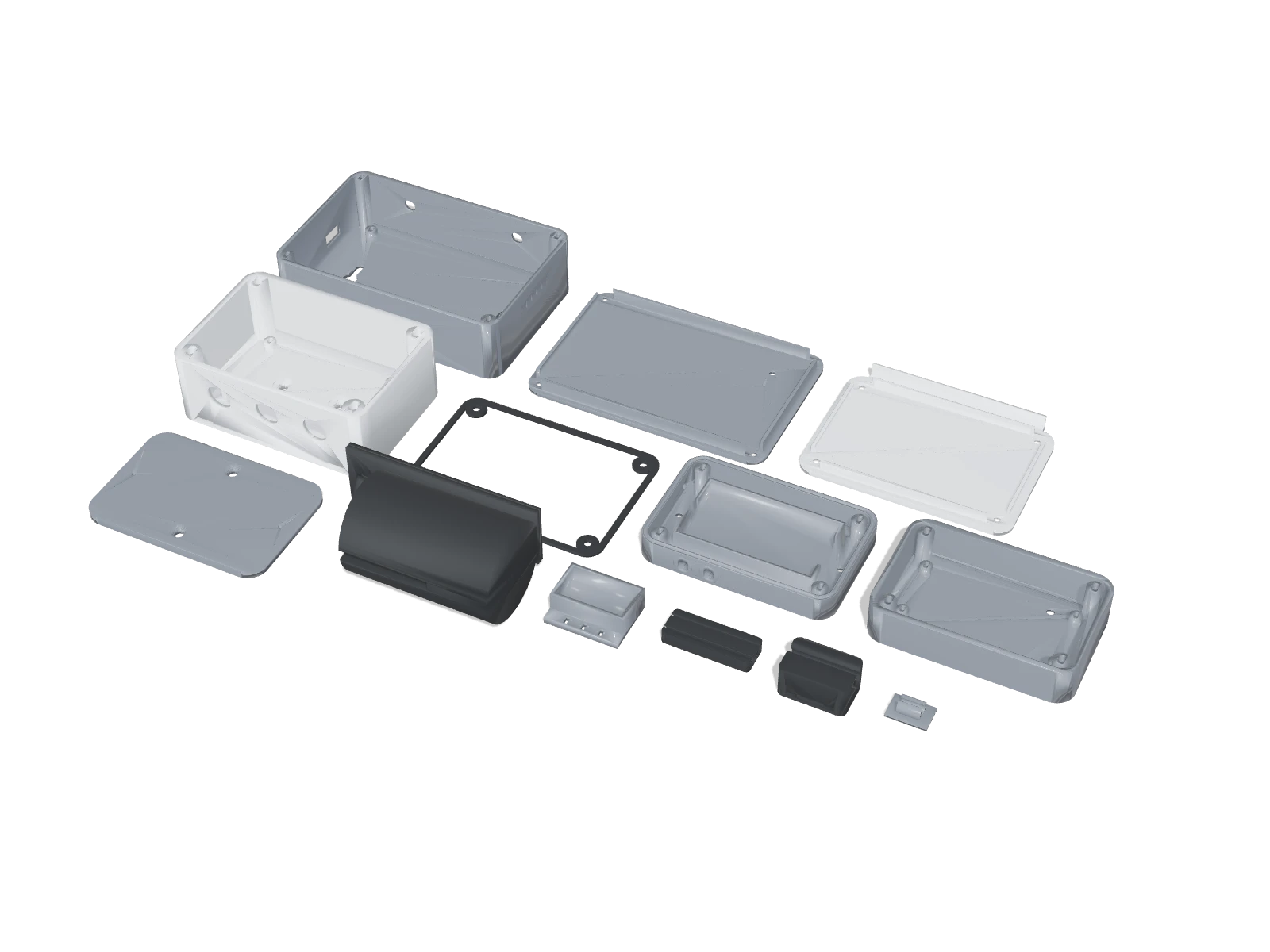
13 parts, generated from code and checked as closed solids. Pick a part to inspect it, or download the STL files to print.
See the CAD parts render
Loading the CAD…
Real CAD · drag to rotate · scroll to zoomReal CAD · swipe sideways
Bought hardware fitted inside this part (checked in the CAD: nothing collides with the plastic)
- Puck toppuck-top.stl · PETG
- Puck bottom and battery cagepuck-bottom.stl · PETG
- Puck magnet mount platemount-plate.stl · PETG
- Door-gasket probe pass-throughprobe-passthrough.stl · TPU 95A
- Air probe clipair-probe-clip.stl · TPU 95A or PA12
- Glycol bottle holderglycol-bottle-holder.stl · TPU 95A or PA12
- Door magnet bracketdoor-magnet-bracket.stl · PETG
- Cable clipcable-clip.stl · PETG / TPU
- Gateway basegateway-base.stl · PETG
- Gateway lidgateway-lid.stl · PETG
- CT node basect-node-base.stl · ASA, white
- CT node lid with rain lipct-node-lid.stl · ASA, white
- CT node gasketct-node-gasket.stl · TPU 95A
Open risks we are working on
- Contractor resale is unproven: kill if fewer than 3 of 10 contractors commit to a paid pilot
- Price pressure from $55–149 no-fee sensors; above about $30/month retail the owner buys a Temp Stick
- Defrost false-alarm target (< 1 per box per week after day 7) is unproven on demand-defrost controls
- Puck antenna next to a steel door frame will detune and must be tuned on a real frame
- Savings rest on unverified failure rates; thresholds are hypotheses until pilot data
- FCC classification of BW500 LoRa as DTS and certification cost ($5–15k est.) not yet confirmed
Design stage only: nothing on this page is for sale. Specifications and prices are targets.