FlowCount Lane
Measured wait times for venue lines, from counts alone
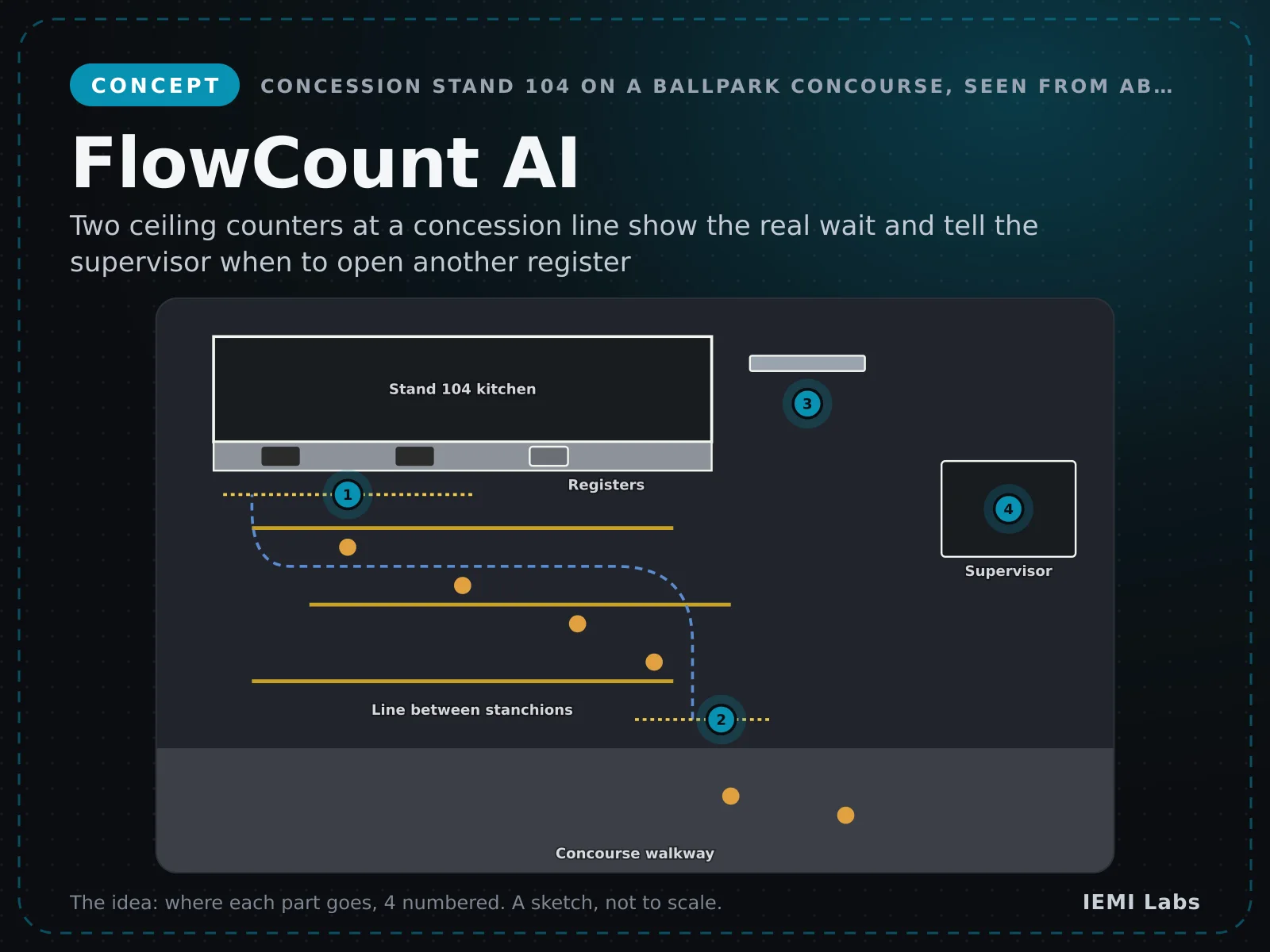
Two ceiling nodes count people into and out of a line; the system works out queue length and each person's wait, shows it on a TV and tells the supervisor when to open another register.
- Who buys it
- Operations or guest-experience manager at a mid-size venue: museum, zoo, aquarium, minor-league ballpark or arena, or university dining.
- Why it pays
- About $10k a year per concession stand from fewer walk-aways at peak (est.), plus staff hours moved to where the lines are.
- Target price
- $649 queue pair + $29/node/month (target); single counting node $349 + $15/month
- First-minute wow
- A TV by the line reads 'Wait about 6 min', and the supervisor gets 'open register 3' two minutes before the line spills onto the concourse. The sensor sends only numbers.
What the research found
And how this design answers it
- Airport tenders against Xovis → mid-size venues and campuses that buy without an integrator
- $899 stereo sensor, the same as the Axis P8815-2 → single IMX500 node at about $135 BOM, $349
- Many stitched sensors per long queue → two count lines and flow conservation, whatever the queue shape
- 'No images leave' as a claim → AI on the sensor, no encoder loaded, setup view timed and lockable, 24 h packet-capture test
- Predicted waits only → measured wait per person from the two count curves, plus Little's-law prediction
- Overlap with StoreSense → small-shop tills left to StoreSense
Use case
Seventh-inning rush at Stand 104
Concessions supervisorStand leadFans in line
- 01Trigger: arrivals at the queue mouth outrun service for three minutes
- 02Detection: 14 in line, 2.1 served per minute, predicted wait about 7 min
- 03Alert: the supervisor gets 'Stand 104: open register 3'; the stand TV shows the wait
- 04Action: a third register opens, service rate rises and the alert clears
Outcome: The line shortens before fans give up; about $150 a game recovered per stand (est.)
How it works
Architecture
- 01
Sense: Sony IMX500 runs a top-down person detector on the sensor; the Pi Zero 2 W tracks and counts line crossings
- 02
Decide: the wait engine computes queue length, service rate, predicted and measured wait, with drift resets
- 03
Send: count deltas every 5 s over MQTT/TLS; no images, no identities
- 04
Tell: TV wait page, public JSON feed, supervisor alerts, Monday report
Hardware
Real parts, buyable today
Bill of materials: about $135 per node at retail qty (est.).
| Block | Part | Why this part |
|---|---|---|
| Sensor + AI | Raspberry Pi AI Camera (Sony IMX500, 66° × 52°) | Detection on the sensor chip; $70 launch price |
| Host | Raspberry Pi Zero 2 W | $15; tracker and line logic at about 1 W |
| Power + network | 802.3af PoE splitter (5 V) + USB Ethernet adapter | One cable at the ceiling, about 3.3 W at the switch |
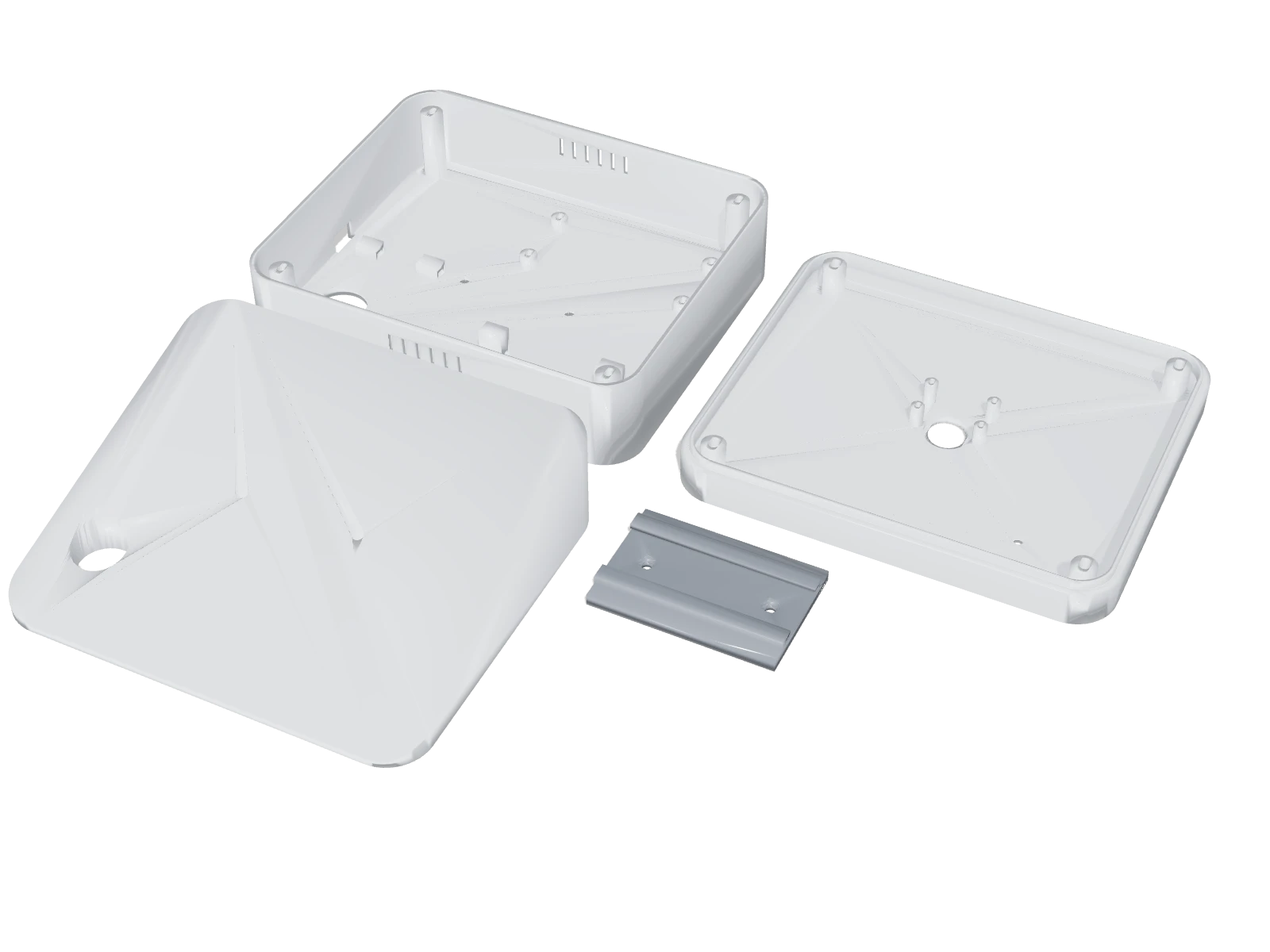
| Housing | 140 × 120 mm printed PETG base and cover, T-bar clip, 15° wedge | Drop-ceiling or hard-ceiling mount; side view for wide entrances |
Mechanical
Printable CAD
4 parts, generated from code and checked as closed solids. Pick a part to inspect it, or download the STL files to print.
See the CAD parts render
Loading the CAD…
Real CAD · drag to rotate · scroll to zoomReal CAD · swipe sideways
Bought hardware fitted inside this part (checked in the CAD: nothing collides with the plastic)
Open risks we are working on
- Top-down detector accuracy on the IMX500, and its Python conversion toolchain the lab doesn't have
- Lines three abreast and strollers break line counts without stanchions
- Venue and university purchasing may still be slow
- The Pi Zero 2 W has no secure boot; a stolen node's key must be revoked
Design stage only: nothing on this page is for sale. Specifications and prices are targets.