LengthLock
The bowling machine you already own, holding the length you set, ball after ball
Makes a club's existing wheel-type bowling or pitching machine smart: a camera behind it measures every ball's length, line and speed, and a servo strapped over the machine's own speed knob nudges it back to the length the coach asked for as balls wear and wheels glaze.
- Who buys it
- Cricket clubs and academies, indoor nets and baseball/softball cages that already own a dial machine (BOLA Junior £1,085, Leverage iWinner $1,349.99, JUGS BP1 $1,895, Junior Hack Attack about $1,900).
- Why it pays
- Coaches stop re-dialling and batters get the ball they came to practise; it replaces a $399.99 radar gun that gives speed only, and flags glazed wheels or worn balls before a session is wasted (est.).
- Target price
- $349 SightCam, $129 per DialDrive, $449 LengthLock Kit, $79 NetKey, $529 Junior Nets Kit (target)
- First-minute wow
- The coach types '6 m, off stump, 110 km/h' on a phone; new balls go in and land short; the DialDrive beeps, turns the knob 4 degrees between balls, and the next balls land back on the 6 m band.
What the research found
And how this design answers it
- ECB Recreational Cricket Safety Regulations (Dec 2025) say machines should be run only by experienced adults, never by U18s, and BOLA says short legs for under-12s and a playable speed per player → rev A2 NetKey pod: the DialDrive moves only after an adult coach card, each batter card sets a speed ceiling the SightCam checks every ball, a short-legs prompt for U11/U12, and a session record for the welfare officer
- Manuals say ball consistency drives accuracy and residue builds on the wheels after about a dozen leather balls → the loop closes on measured length, so it corrects drift whatever the cause, and flags the wheels when the correction keeps growing
- Dial numbers are not speeds (light balls come out faster; two machines differ by 5–10 mph) → the SightCam learns each machine's dial-to-speed map per ball type
- A radar gun gives speed only, at about ±1 mph → the CAD report shows a 2 km/h drift moves the bounce 150–210 mm while the camera resolves length to 9–31 mm, so the loop holds length, the thing the batter feels
- Modifying a machine that throws at people is a warranty and liability worry → the DialDrive straps on, is never wired into the machine, announces every move, respects a coach speed ceiling and goes limp on any fault
- Newer machines use membrane keys or tablets → rev A is honest that the DialDrive fits rotary knobs only; other machines get SightCam advice, and a maker partnership is the route to the loop
Use case
Academy nets: new balls land short
Coach / feederBatterAcademy owner
- 01Trigger: the coach sets good length (6 m), off stump, 110 km/h and swaps in a new set of balls
- 02Detection: the SightCam fits each ball's arc and finds the last 3 bounces 0.4 m short of target
- 03Action: the DialDrive beeps twice, lights amber and turns the speed knob 3.8 degrees between balls
- 04Outcome check: the next balls land on the 6 m band; the log shows 31 of 36 balls in the band and a wheel-health trend for the owner
Outcome: A full session at the length the batter needed, without the coach chasing the dial (est.)
How it works
Architecture
- 01
Sense: Raspberry Pi Global Shutter Camera (IMX296, 60 fps) 2 m up behind the machine
- 02
Decide: Raspberry Pi 5 finds the ball by background subtraction, fits pre- and post-bounce arcs, maps the bounce to metres and runs a capped length controller
- 03
Send: Wi-Fi from the SightCam's own access point to the DialDrive and the coach's phone
- 04
Act and tell: DS3218 servo turns the speed knob after a 2 s beep and amber light; per-ball log and health flags on the phone
Hardware
Real parts, buyable today
Bill of materials: about $232 per SightCam, $60 per DialDrive, $51 per NetKey with 20 cards; $342 per Junior Nets Kit at qty 1 (est.).
| Block | Part | Why this part |
|---|---|---|
| SightCam camera | Raspberry Pi Global Shutter Camera + 6 mm CS lens | No rolling-shutter smear on a 140 km/h ball; 9–31 mm length error at the bounce (computed) |
| SightCam compute | Raspberry Pi 5 2GB + Active Cooler | Classical tracking at 60 fps on the CPU, no AI accelerator needed |
| DialDrive actuator | DS3218 20 kg-cm 270 degree servo (IP66) + 25T disc horn + printed coupler | Turns the machine's own knob; removable, nothing wired in |
| DialDrive control | Seeed XIAO ESP32C3 + Pololu D36V28F6 and D24V5F5 | Wi-Fi link and servo power from the machine's 12 V battery |
| Power | 20,000 mAh USB-C PD bank (SightCam), machine 12 V battery (DialDrive) | 11.4 h of tracking per charge (est.) |
| NetKey pod (Junior Nets) | PN532 NFC module + Waveshare 1.54in e-paper + XIAO ESP32C3 + 1000 mAh LiPo | Coach and batter cards, sun-readable prompts, about 4 three-hour sessions per charge (est.) |
Mechanical
Printable CAD
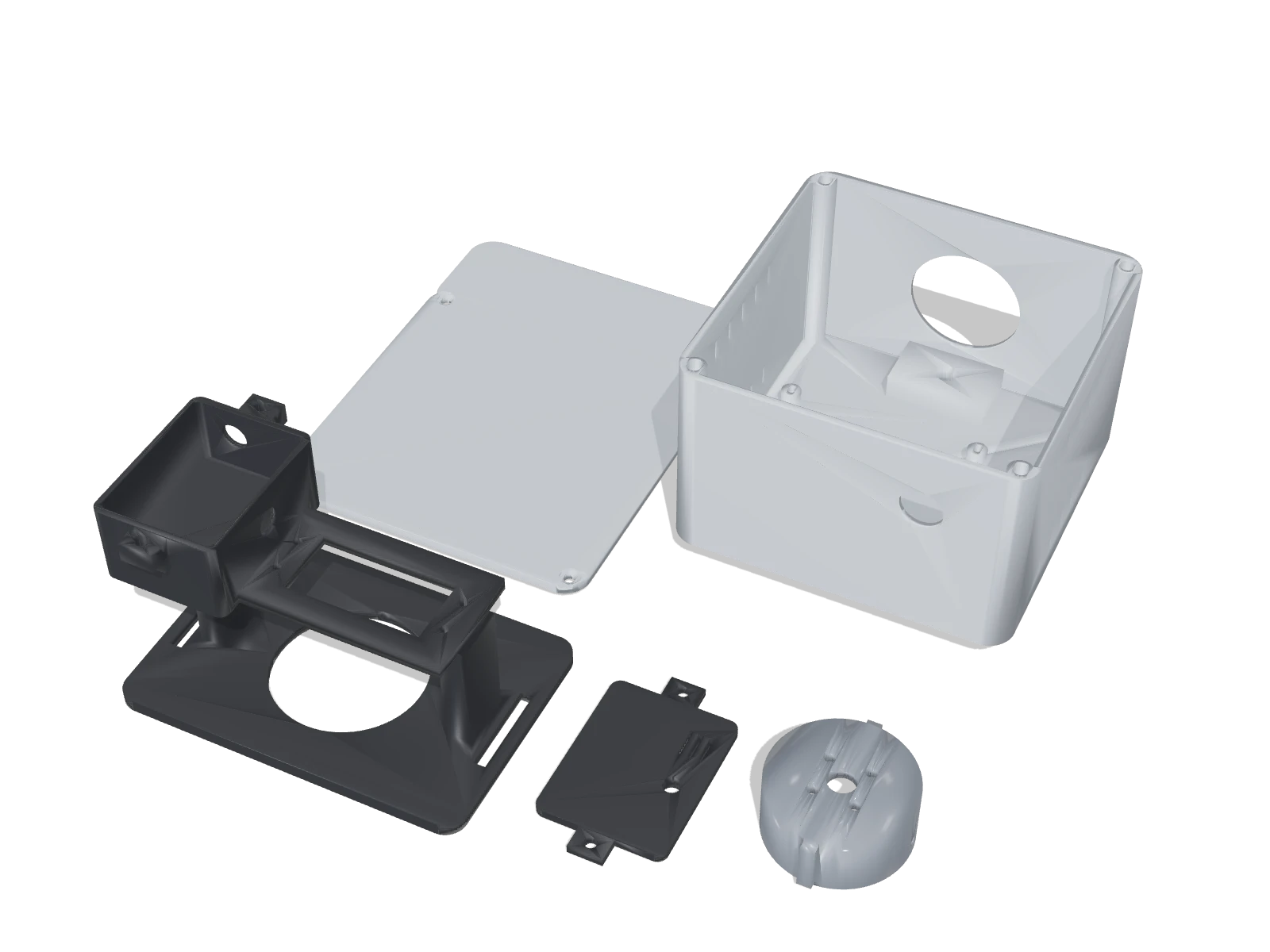
7 parts, generated from code and checked as closed solids. Pick a part to inspect it, or download the STL files to print.
See the CAD parts render
Loading the CAD…
Real CAD · drag to rotate · scroll to zoomReal CAD · swipe sideways
Bought hardware fitted inside this part (checked in the CAD: nothing collides with the plastic)
- SightCam case with Pi 5 standoffs, camera pedestal and tripod bosssightcam-case.stl · ASA
- SightCam lid with sun and rain visor over the lenssightcam-lid.stl · ASA
- DialDrive bridge: strap base, servo deck and electronics tubdialdrive-frame.stl · ASA
- DialDrive tub lid with amber LED and buzzer slotsdialdrive-lid.stl · ASA
- Knob coupler cup (bore made per machine model)dialdrive-coupler.stl · PETG
- NetKey case with strap tunnel and USB-C portnetkey-case.stl · ASA
- NetKey lid with TAP HERE card dish, e-paper window and two buttonsnetkey-lid.stl · ASA
Open risks we are working on
- Rotary knobs only in rev A: the BOLA Professional (membrane keys) and tablet machines get advice, not the closed loop, unless a maker partners
- Phone apps such as FullTrack AI already make pitch maps from one phone; if coaches do not value the loop, the SightCam alone is a hard sell
- BOLA, Leverage or JUGS could add a camera and closed loop natively
- Clubs or insurers may object to a servo on a machine that throws at people, even removable and announced; no safety claims are made
- Accuracy is computed, not measured: bounce length vs. chalk marks and speed vs. radar are the first bench tests
- Junior Nets Mode cannot stop a person feeding balls by hand or check helmets; it refuses to move the knob without a coach card and records what happened, and no welfare officer has reviewed it yet
Design stage only: nothing on this page is for sale. Specifications and prices are targets.