PitchTally
The umpire's indicator made smart: pitch counts, rest days that follow the pitcher between teams, a 20-second pitch clock and tournament bat checks for baseball, spell limits and an over-rate clock for cricket
Upgrades the ball/strike clicker every plate umpire carries into a Tally with a sun-readable e-paper count and haptic cues, adds a BackstopPod whose 24 GHz radar counts every pitch, adds a pitcher-facing PaceFace clock that times the NFHS 20-second rule from the catcher's return throw, and in cricket keeps each young fast bowler's overs, spells and rest (SpellCount) and runs a club T20 innings clock with overs due versus bowled and the incoming batter's countdown (OverRate); at tournaments a BatCheck ring gauge with a label camera checks each bat's mark, barrel and the decertified list and builds the plate-meeting card the head coach affirms; and an orange RestPass tag laced to each pitcher's glove carries every outing from every team (pitches, innings caught, date), so any coach taps it before a game and sees whether the player may pitch or catch today under Little League or Pitch Smart rest rules.
- Who buys it
- Youth baseball league boards (one pod per field), high-school athletic directors and conferences (a PaceClock Kit per field), travel-ball and Little League tournament directors (a BatCheck Kit per field), junior cricket clubs and leagues, club T20 leagues and their umpires (an OverRate Kit per ground); travel-ball coaches and parents (a RestPass Team Pack); individual umpires buy the Tally alone. Today they use a $9–30 mechanical indicator, a stopwatch or nothing, a paper book or a free scoring app.
- Why it pays
- Ends the 'split the difference' pitch-count arguments and the protests and forfeits that follow an ineligible pitcher (est.); a $449 Field Kit target costs about what one Pocket Radar Smart Coach does and also keeps the count.
- Target price
- $29 RestPass Team Pack, $59 Tally, $79 BatCheck Kit, $99 SpellCount Pair (cricket), $279 OverRate Kit (cricket), $299 PaceClock Kit, $329 TimeLimit Kit (PaceClock + $49 lamp add-on), $449 Field Kit, $699 PaceClock Field Kit (target)
- First-minute wow
- The visitors' coach says the pitcher is at 87; the recorder opens the pod's page, which shows 85 pitches each with time, speed and the umpire's call, and one amber pitch the home book missed. Settled in 20 seconds.
What the research found
And how this design answers it
- Pitch-count books disagree between home, visitors and dugouts → one neutral radar count that every phone at the field reads, with a pitch-by-pitch log for disputes
- The rules name a human official pitch count recorder → the pod is an aid: the recorder confirms pitcher changes and corrections, and every correction is logged
- Junior cricket: ECB Fast Bowling Match Directives cap a young fast bowler's overs per spell and per day and set rest overs from the same end, and umpires are asked to keep the record → SpellCount kit: cricket key mat (BALL, EXTRA, BOWLER, UNDO) and a waistband holster; the Tally keeps every bowler's spells, rests and day total against the league's table, buzzes on the last over of a spell and warns when a resting bowler is named (14/14 rule checks)
- High-school baseball: NFHS 6-2-2c gives the pitcher 20 seconds (a ball if late) and 60 s between innings, but umpires say it is rarely enforced with no visible clock (Umpire-Empire, OSAA) → PaceClock kit: a pitcher-facing PaceFace with two 6.5-inch digits, started by the radar on the catcher's return throw, a TIME key for step-offs and feints, a 5-second Tally buzz and a dark umpire-only mode; the umpire still decides the penalty
- Club T20: leagues set a hard innings time with in-match penalties (NWCL 75 min and 10 runs per full over short, 90 s for a new batter; GMACL 80 min, an extra fielder in the circle and 5 runs per over), and the umpires keep it on a wristwatch nobody else sees → OverRate kit: a cricket key mat (BALL, WICKET, STOP, UNDO), the PaceFace hung on a scaffold tube by the pavilion with two printed clamps showing innings minutes left or the new batter's 90 s, and a Tally that buzzes when a side is an over behind; the umpires grant allowances and decide every penalty (14/14 rule checks)
- Tournament bat and catcher-gear checks: Little League tells umpires to check every bat's mark, damage and the decertified list and hand illegal bats to the tournament director; NFHS makes the head coach verify all players are legally equipped and a used illegal bat an out → BatCheck kit: a 2 5/8 in and 2 3/4 in ring gauge with a camera that reads the mark and model, a division table, a synced decertified list, orange NFC HOLD tags, and a plate-meeting card with the catcher's NOCSAE photos that the coach affirms; the umpire decides (12/12 rule checks)
- Youth rest days do not follow the pitcher between teams: Little League says nothing stops 50 travel pitches on Sunday and 50 league pitches on Monday and leaves it to parents; in 2019 tournaments 43% of pitchers broke Pitch Smart rest (Greiner 2021) → RestPass: an orange NFC tag laced to the glove holds every outing from every team; one tap shows ELIGIBLE and today's limit, or the first legal day, plus the catcher rules (12/12 rule checks)
- Tournament time limits: each event writes its own (USSSA Tennessee no new inning after 1:30 for 9U–12U, Nebraska 1:40, a Syracuse league 75 min with a 90-min drop-dead that reverts a visitor lead) and only the umpire's watch knows the time → TimeLimit lamp on the PaceFace: green, amber in the last 10 min, red flash for the last inning, red at drop-dead; the umpire starts it on the Tally and the third OUT decides the next inning
Use case
Little League Majors game, home pitcher near the 85-pitch limit
Plate umpireOfficial pitch count recorderBoth managers
- 01Trigger: the recorder enters both starting pitchers on the pod's page; the umpire pairs the Tally
- 02Detection: the radar sees each inbound pitch for 290–480 ms and counts it; the umpire's BALL or STRIKE key closes it
- 03Alert: at 80 the Tally gives one long buzz and the recorder's page goes amber; at 85 two buzzes mean finish this batter
- 04Action: the manager changes pitchers; any dispute is settled from the pitch log
Outcome: No protest and a rest-day record both teams accept (est.)
How it works
Architecture
- 01
Sense: OmniPreSense OPS243-A 24 GHz Doppler radar behind the backstop; the umpire's 4 keys
- 02
Decide: XIAO ESP32-S3 turns radar tracks into pitches and merges them with ball, strike and out keys
- 03
Send: BLE to the Tally; a local Wi-Fi access point serves the recorder and dugout pages, no internet needed
- 04
Tell: Tally e-paper and haptic, the pod's 7-segment count, phone pages with count, rest days and pitch log
Hardware
Real parts, buyable today
Bill of materials: about $10 per 12-tag RestPass Team Pack, $35 per Tally, $32 per BatCheck Kit, $37 per SpellCount Tally, $175 per PaceFace, $10 per TimeLimit lamp, $221 per OverRate Kit, $334 per BackstopPod, $405 per Field Kit, $580 per PaceClock Field Kit at qty 1 (est.).
| Block | Part | Why this part |
|---|---|---|
| Radar | OmniPreSense OPS243-A (75 x 90 x 12 mm, 1.5 W, 20 deg beam) | Speed with inbound/outbound direction, so return throws are ignored without any camera |
| Pod MCU | Seeed XIAO ESP32-S3 | UART to the radar, BLE to the Tally and a Wi-Fi access point for phones |
| Pod display + power | Adafruit 1270 1.2 inch 7-segment, Adafruit 5035 10,050 mAh + PowerBoost 1000C | Count visible at the plate; 13.1 h per charge (est.) |
| Tally MCU + display | Seeed XIAO ESP32-C3, Waveshare 1.54 inch e-Paper | Sun-readable like printed dials; about 224 h on 500 mAh (est.) |
| Tally keys + haptic | 4 x 6 mm tact switches under a TPU key mat, Adafruit 1201 coin motor | Found by feel with tall BALL and STRIKE caps; silent cues to the umpire |
| PaceFace clock | 2 x SparkFun COM-08530 6.5-inch digits + Large Digit Drivers, XIAO ESP32-C3, 12 V 3000 mAh pack | 153 mm digits a pitcher can read from the mound (est., to test in sun); ESP-NOW from the pod |
| OverRate mount | 2 x printed rateface-clamp on a 48.3 mm scaffold tube, M6 thumb screws in heat-set inserts | Hangs the same PaceFace by the pavilion gate or scorebox without drilling; no chain-link needed |
| BatCheck gauge | Printed 2 5/8 in + 2 3/4 in ring gauge, Seeed XIAO ESP32-S3 Sense camera, 500 mAh LiPo, NTAG215 HOLD tags | Mark, model and barrel checked in one move per bat; held bats are traceable to the tournament director |
Mechanical
Printable CAD
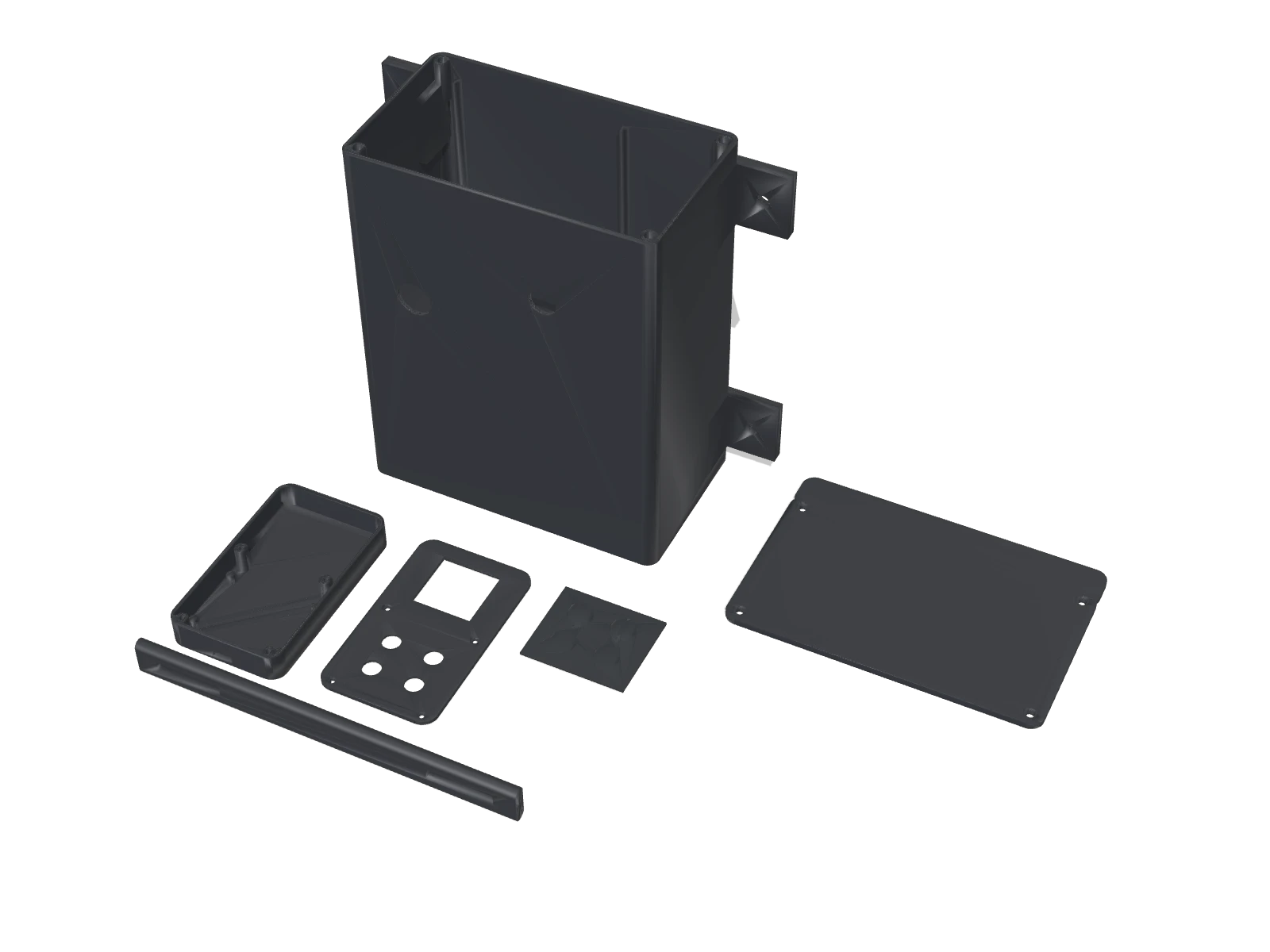
20 parts, generated from code and checked as closed solids. Pick a part to inspect it, or download the STL files to print.
See the CAD parts render
Loading the CAD…
Real CAD · drag to rotate · scroll to zoomReal CAD · swipe sideways
Bought hardware fitted inside this part (checked in the CAD: nothing collides with the plastic)
- Tally base with e-paper ribs, key-board posts and lanyard looptally-base.stl · ASA
- Tally lid with e-paper window, key holes and key-mat recesstally-lid.stl · ASA
- Tally TPU key mat: BALL, STRIKE (tall), OUT, UNDO (low)tally-keys.stl · TPU
- BackstopPod case: radome front wall, display window, shelf and fence tabspod-case.stl · ASA
- BackstopPod lid with rain visorpod-lid.stl · ASA
- Fence bar on the field side of the chain-link (print 2)fence-bar.stl · ASA
- SpellCount cricket key mat: BALL, EXTRA (tall), BOWLER, UNDO (low)spell-keys.stl · TPU
- SpellCount waistband holster with belt tongue and USB-C slotspell-holster.stl · ASA
- PaceClock TPU key mat: BALL, STRIKE (tall), OUT, TIME (low, T ridge)pace-keys.stl · TPU
- PaceFace case: two 6.5-inch digit windows, battery bay and top and bottom fence tabspaceface-case.stl · ASA
- PaceFace back cover with locating skirtpaceface-back.stl · ASA
- PaceFace field-side fence bar, 210 mm slot centres (print 2)paceface-bar.stl · ASA
- OverRate cricket key mat: BALL, WICKET (tall), STOP, UNDO (low)over-keys.stl · TPU
- RateFace scaffold-tube clamp with M6 insert ring (print 2, lower one turned over)rateface-clamp.stl · ASA
- BatCheck ring gauge: 2 5/8 in and 2 3/4 in bores with camera podbatring.stl · ASA
- BatCheck pod lid with camera window and glove-friendly SNAP keybatring-lid.stl · ASA
- HOLD tag: orange clip for a bat taken out of play, NFC sticker recess (print several)hold-tag.stl · TPU
- RestPass glove tag: orange TPU tag laced to the pitcher's glove, NTAG216 sticker pocket (one per pitcher)glove-tag.stl · TPU
- TimeLimit lamp bar: sits on top of the PaceFace, hooks over the back cover, NeoPixel Stick 8 insidelimitlamp-base.stl · ASA
- TimeLimit lamp lens: frosted cap that glows green, amber or red for both dugoutslimitlamp-lens.stl · PETG
Open risks we are working on
- The OPS243-A radar is $224, two-thirds of the pod; the target price needs a rev B own-radar cost-down
- GameChanger is free and Little League's official pitch count technology; we may end up as hardware that feeds it, if they allow imports
- Radar loss through 2 inch chain-link is estimated, not measured; low backstops need a mast
- Whether umpires may use an electronic indicator, and how leagues treat a radar count, has not been checked with Little League or umpire associations
- Cricket: the ECB directives were read via county and school copies; a newer ECB revision and local readings of the 'same end' rest rule must be checked with an umpires' association
- High school: NFHS 6-2-2c was read via forum quotes and an NFHS pace-of-play document, not the 2026 rule book; state associations decide on visible clocks, and readability of 6.5-inch digits at about 120 ft in sun is untested
- Club T20: innings times, allowances and penalties differ by league and were read from three handbooks; the 6.5-inch face is readable to about 30 m, so players in the middle rely on the umpires, and a league must adopt the clock before it is shown in a match
- TimeLimit: the lamp is only as right as the umpire's start press and the agreed start point (first pitch or plate meeting); each tournament's rule must be entered before play
Design stage only: nothing on this page is for sale. Specifications and prices are targets.